This is the second time I’ve written this. The first came shortly after MagicCon Chicago in 2024. It was the first time I wrote anything with the intention of recording it as a video essay and it’s still up on my YouTube, but god it’s rough. It was unpolished, rushed, and the first thing I’d written in years that wasn’t poetry. So, after a year and a half I wanted to revisit my thoughts on the topic. This is exactly that, I hope you enjoy my love letter to storytelling in Amonkhet
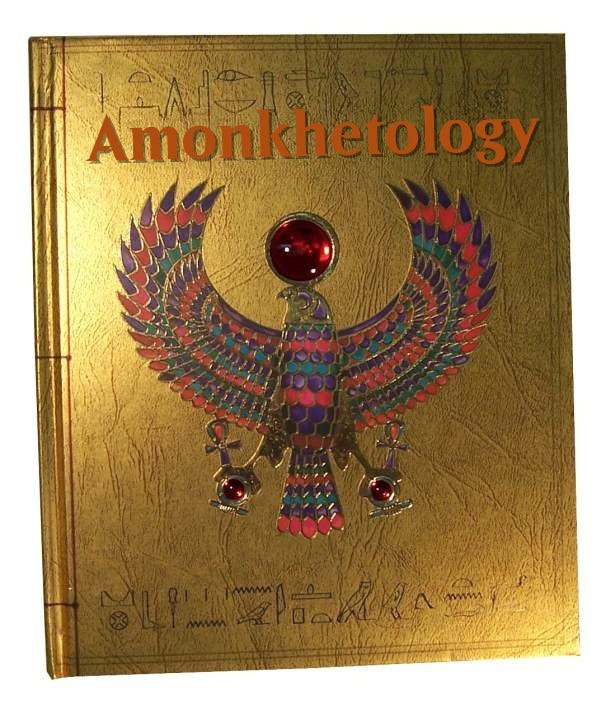
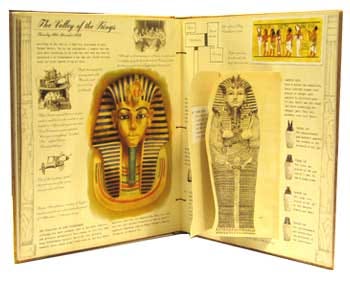
In 5th grade, I remember it fondly, I bought THE Egyptology book from the Scholastic Book Fair. You know the one—big, glossy pages, fake “ancient” letters tucked into envelopes, little foldouts that made it feel like you were uncovering secrets from thousands of years ago.
I read it cover to cover, more times than I can count. That was the spark for my fascination with Ancient Egypt and its rituals, monuments and people.
So, in 2017, when Magic: The Gathering released Amonkhet, it felt familiar enough that I went to my first pre-release vent for it. The setting wasn’t just another fantasy plane to me—it carried the weight of rituals, faith, and myth in ways that reminded me of those early stories I fell in love with.
Before anyone types a thing about Theros or any other mythologically inspired plane, just know that I didn’t connect with Ancient Greek or really anything on the same level, so they just didn’t call to me in the same way.
Everything on Amonkhet was built around belief in the God-Pharaoh, in the trials, in the afterlife. And yet, just like in Ancient Egyptian writing, that faith was complicated and layered with betrayal.
In this “article,” I want to reflect on why Amonkhet is still one of my favorite planes, not just because it’s beautiful or tragic, but because of how its storytelling lines up with Ancient Egyptian traditions. We’ll look at the role of poetry, and even one of Egypt’s greatest tales—the Tale of Sinuhe—to see how both Egypt and Amonkhet used story to hold onto faith, even when that faith was shaken.
Rituals of the Amonkheti
What first drew me into Ancient Egypt wasn’t even the pyramids or the pharaohs—it was the rituals. I remember poring over those pages from the book fair, stopping at the little fold-outs that showed funerary practices or the journey into the afterlife. Every gesture, every symbol, every chant mattered. It was a society that built its entire identity on the idea that what you did in this life shaped the eternity waiting for you. That sense of order, of faith woven into every action, really fascinated me as a kid—and if I’m honest, it still does.
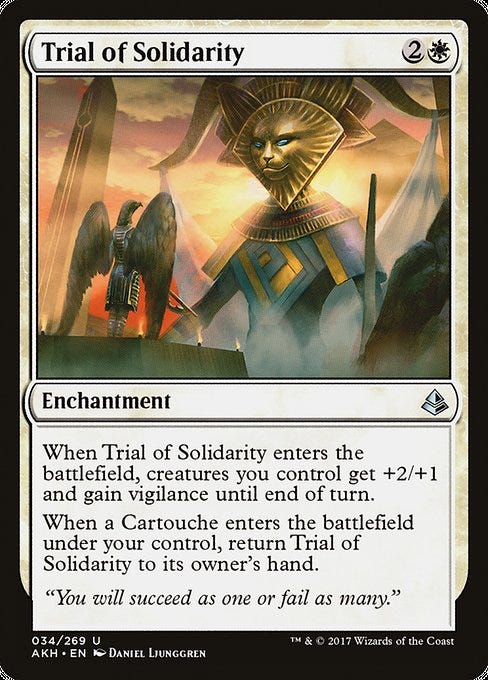
When Amonkhet arrived in Magic, I saw that same weight of ritual everywhere. Life in Naktamun was defined by the five trials, each a step closer to eternity. To pass through them was to prove not just strength, but worthiness in the eyes of the God-Pharaoh. The Trial of Solidarity demanded unity with others,
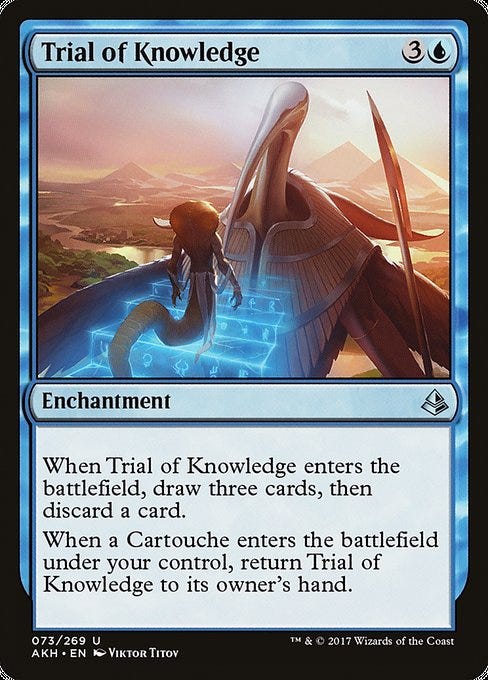
the Trial of Knowledge forced clarity of mind,
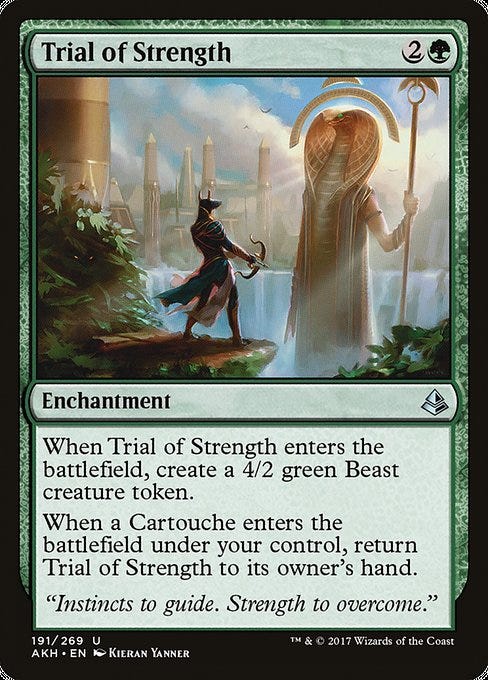
the Trial of Strength tested raw will and combat,
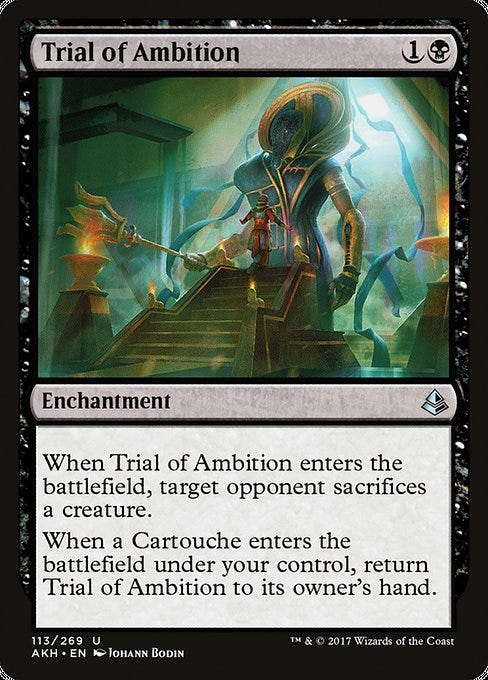
the Trial of Ambition pushed you to grasp for more,
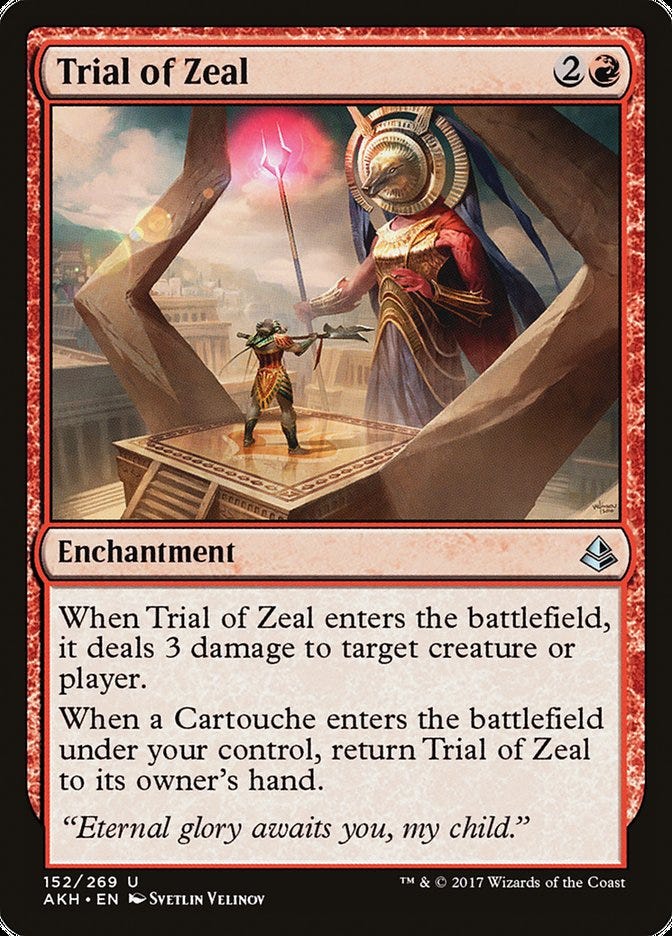
and the Trial of Zeal asked for relentless devotion.
Each trial was sacred, each overseen by a god who embodied its ideal. For the people of Amonkhet, these weren’t just competitions—they were the very shape of life, milestones to measure whether you deserved the afterlife you’d been promised.
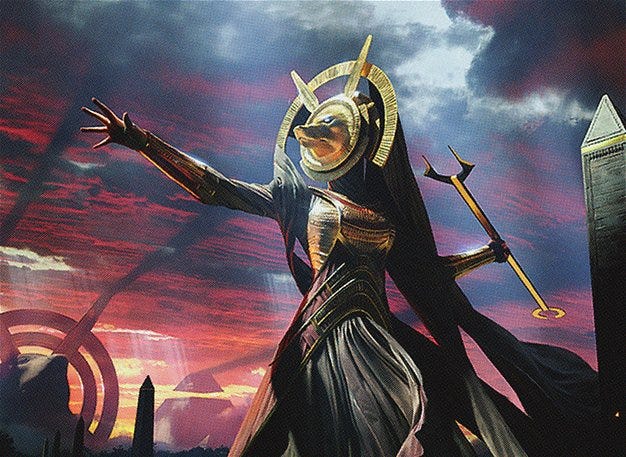
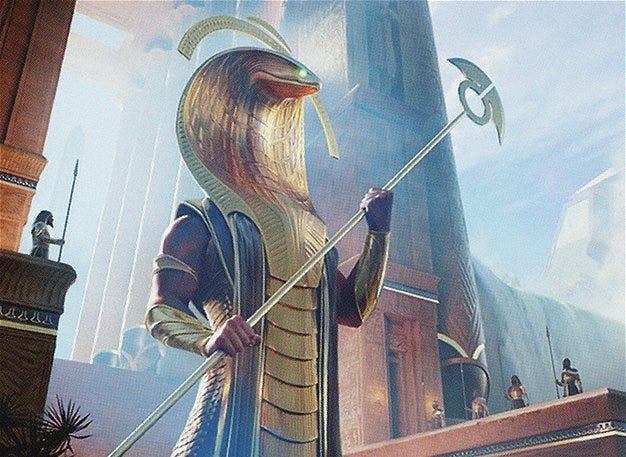
And then there were the gods themselves that oversaw these trials. Hazoret, the god of zeal, fierce and loyal, who truly loved her people even when she didn’t fully understand the lies she was caught in.
Kefnet, the god of knowledge, wise but distant, keeping the mystery of the trials alive.
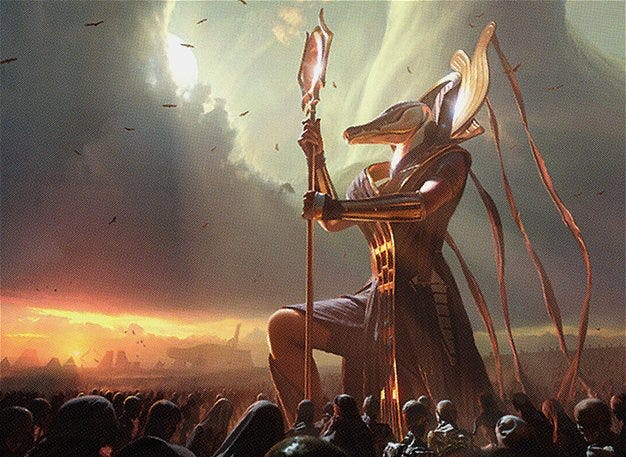
Rhonas, god of strength, towering and relentless.
Bontu, the god of ambition, sly and selfish in a way that felt just a little too on the nose, even before we knew the full truth.
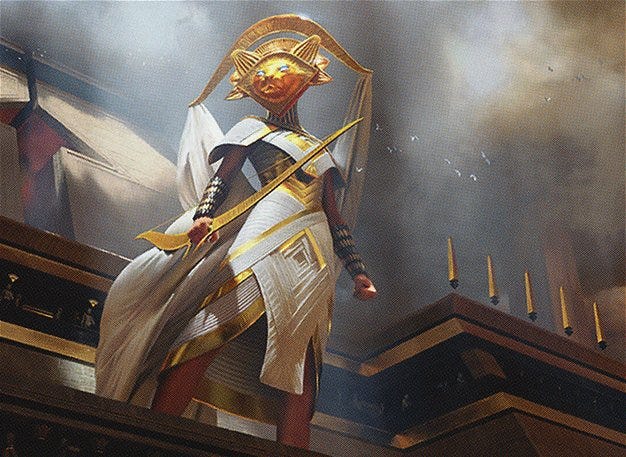
And Oketra, the god of solidarity, who represented community and grace.
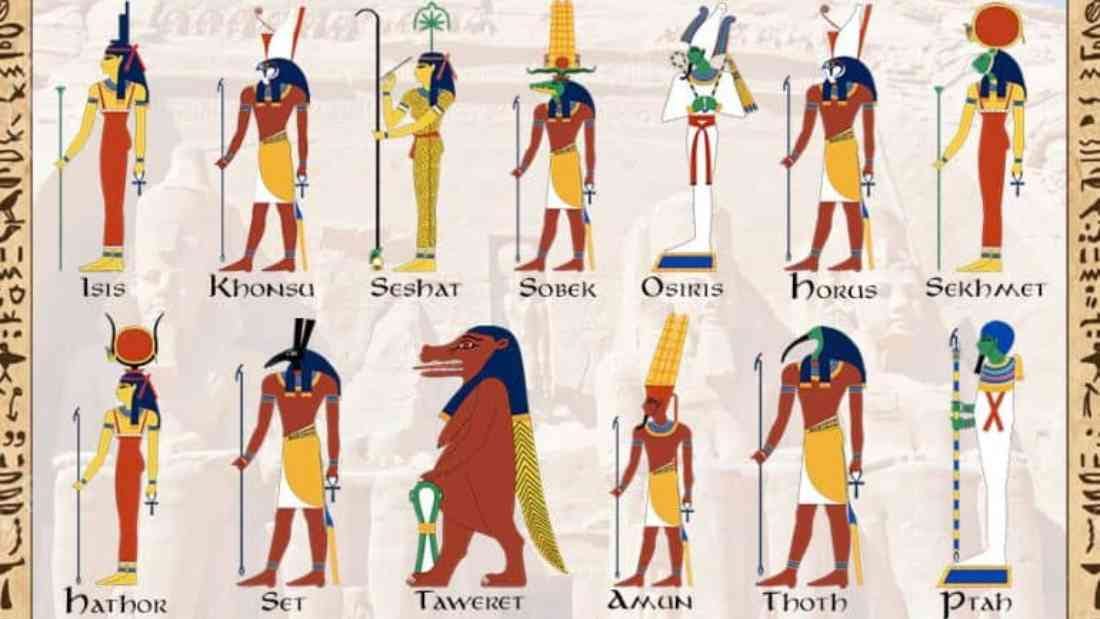
The pantheon of Amonkhet felt pulled from the same place that made me fall in love with Egyptian mythology all those years ago. Each god wasn’t just a figure to worship—they were living embodiments of ideals, teachers, protectors, and even, ultimately, betrayers.
The Pantheon of Ancient Egyptian Gods – A Comprehensive Guide – Anthropology Review
Just like the gods of ancient Egypt, they were complex, sometimes loving, sometimes cruel, but always present in the rhythms of daily life.
On the surface, it all felt glorious—noble even. The kind of thing my younger self, still entranced by those Egyptian myths, would have thought was beautiful. But the tragedy, of course, is that every one of these rituals was nothing but a cage. Nicol Bolas had twisted the trials and the gods into tools of control long ago, promising eternity but only delivering death. That betrayal stings, but it also makes the setting so rich. Faith isn’t simple. Whether in history or in Magic’s storytelling, faith is always this mix of beauty and danger, of devotion and manipulation.
And that’s why Amonkhet still resonates with me. It takes the awe I felt as a kid reading about real-world rituals and refracts it through fantasy, showing both the dignity of belief and the tragedy of what happens when that belief is corrupted.
Poetry of the Dead
Now, what’s always struck me about Amonkhet is how its flavor text feels more like poetry than exposition. It doesn’t just tell you facts about the world—it carries the belief of that world’s people. That’s exactly how poetry functioned in Ancient Egypt. Poetry wasn’t written to entertain or even to be “art” in the modern sense; it was a ritual of language, a way of affirming faith and relationship to the divine. These were recited in front of people, spoken aloud so that the gods would hear them.
Take The Great Hymn to the Aten, one of the most famous Egyptian poems:
“Thou risest beautifully, O thou Living Aten, Lord of Eternity! Thou art sparkling … beautiful, [and] mighty.” — Great Hymn to the Aten (Lichtheim & Fischer-Elfert, 2006)
Or later in the same hymn:
“Though thou art far, thy rays are upon the earth; they are in men’s faces as one beholds them.” — Great Hymn to the Aten (Lichtheim & Fischer-Elfert, 2006)
These lines aren’t just describing the sun—they’re enacting devotion to a being that they believe lives and breathes to protect them. They’re affirmations, repeated like a chorus, turning the natural light of the sun into the divine presence of a god.
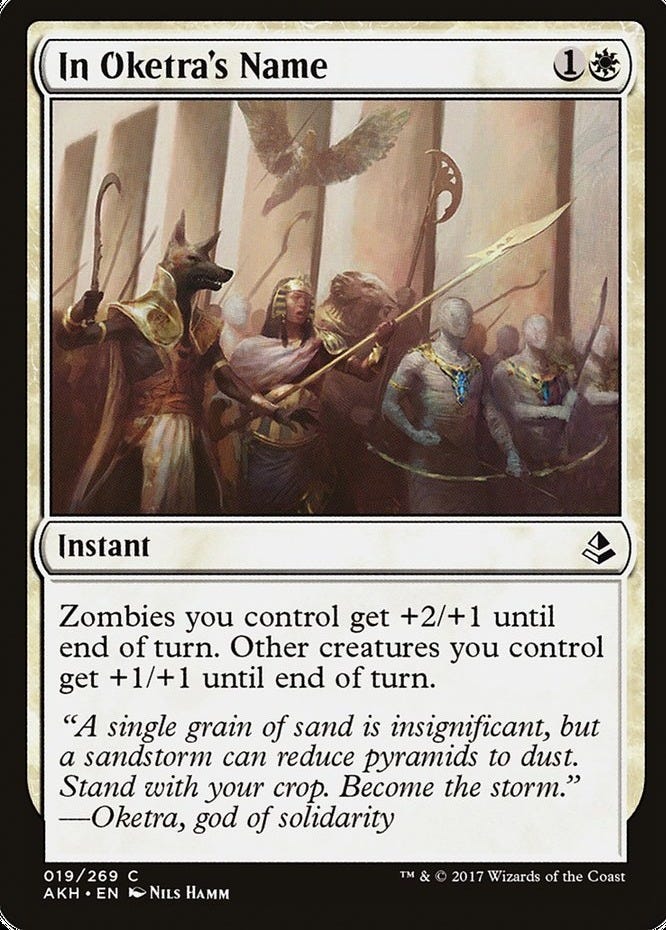
When I read the flavor text in Amonkhet—whether on Trial of Solidarity or In Oketra’s Name—I see the same technique at work. For example, In Oketra’s Name declares:
“A single grain of sand is insignificant, but a sandstorm can reduce pyramids to dust. Stand with your crop. Become the storm.”
—Oketra, god of solidarity
The lines are short, ritualistic, and symbolic. It isn’t about plot—it’s about belief. It echoes the Egyptian practice of speaking, inscribing, or erasing names as a way of preserving or denying someone’s afterlife. Just like the hymns to Aten, it shows that words aren’t just language, they are power.
Another Egyptian poem, The Harper’s Song—a genre often sung at funerals—says:
“Make holiday, do not weary of it! Behold, it is not given to man to take his property with him. Behold, no one who has gone comes back again.” — The Harper’s Song (Lichtheim & Fischer-Elfert, 2006)
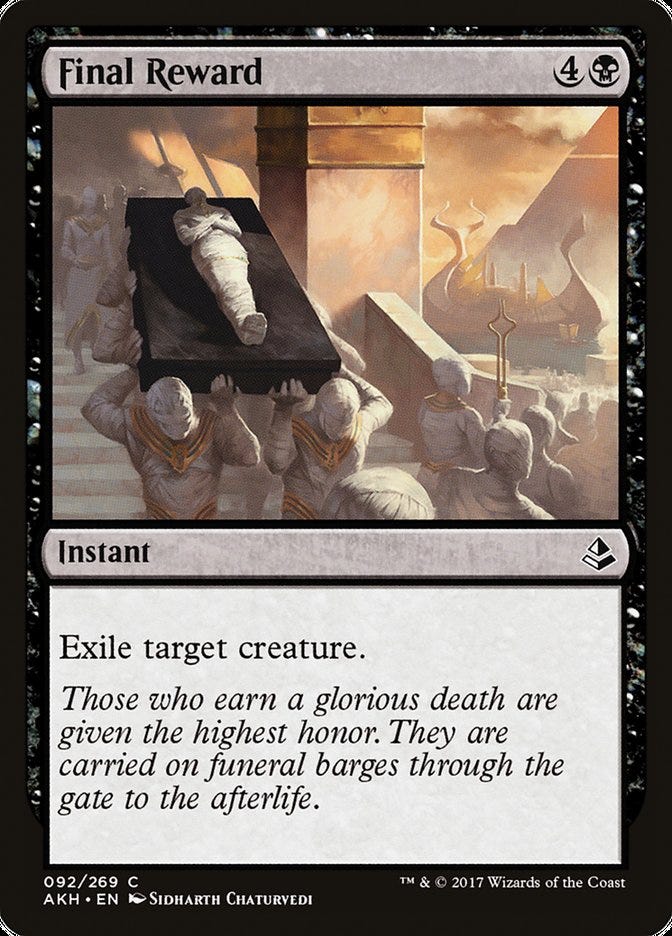
It’s both a lament and a reminder: celebrate, because death is certain. Compare that to flavor text like Final Reward:
“Those who earn a glorious death are given the highest honor. They are carried on funeral barges through the gate to the afterlife.”
Here, too, the poetry is the ritualized acceptance of death, even celebration of it, as a pathway to divine order. Just like the Harper’s Song frames death as inevitable but meaningful, Amonkhet frames sacrifice as both tragic and holy.
That’s what makes the flavor text of Amonkhet feel like Egyptian poetry. Both rely on brevity, repetition, and ritual tone to collapse belief and experience into a handful of words. A card’s single line becomes a hymn, a prayer, a whisper of the culture’s soul.
Sinuhe’s Longing, Amonkhet’s Betrayal
Egyptian hymns and funeral songs show us the ritual side of faith, the painstaking and often unrequited aspect of belief. However, The Tale of Sinuhe shows us something more vulnerable—the private, messy, human side. It’s a story almost 4,000 years old, but when I first read it in my college Humanities course, I felt like I was reading someone’s journal. Sinuhe isn’t a hero. He’s not a chosen one. He’s just a man who panics and runs away. A man that spends years trying to figure out who he is, all while away from home.
The story begins with the sudden death of Pharaoh Amenemhat I. In this chaos, Sinuhe fears that he could be hurt or killed in the chaos and flees Egypt, terrified of what might happen next. He wanders through deserts, foreign lands, foreign courts, and though he builds a life for himself abroad, he never stops aching for Egypt. A line that sticks with me most is his descriptions of thirst:
“An attack of thirst overtook me; I was parched, my throat burned, and I said: ‘This is the taste of death.’” — The Tale of Sinuhe (Bullock, 1978)
“This is the taste of death.” That line isn’t just about water—it’s about longing. It’s about being cut off from the place and the people that made you. That thirst becomes a metaphor for exile, and for the way absence can hollow you out.
Here’s the thing though, he thrives in Syria. He is taken in by Amunenshi, the ruler of upper Retjenu. He gets made a leader in his armies, and even wins major conflicts. That’s where Sinuhe hits me hardest. He prospers in exile, sure—he marries, he fights, he wins honor—but none of it matters, because it isn’t Egypt. That’s the part that made me stop and reflect. How can a man forced into exile by a country still yearn to be home in said country? Despite everything he ran away from we still see him plead with his gods:
“Whatever god fated the flight—be gracious, and bring me home! Surely you will let me see the place where my heart still stays! What matters more than my being buried in the land where I was born?” — The Tale of Sinuhe (Bullock, 1978)
We can feel his desperation to run away again, only this time he begs for the chance to run back to Egypt, and I think I understand why. In time I’ve realized that just because we succeed, and even when everything looks fine from the outside, it’s possible to still feel like a stranger in your own life. I have to imagine that this is a familiar feeling for those still living in Amonkhet even after the fall of the Great Deceiver.
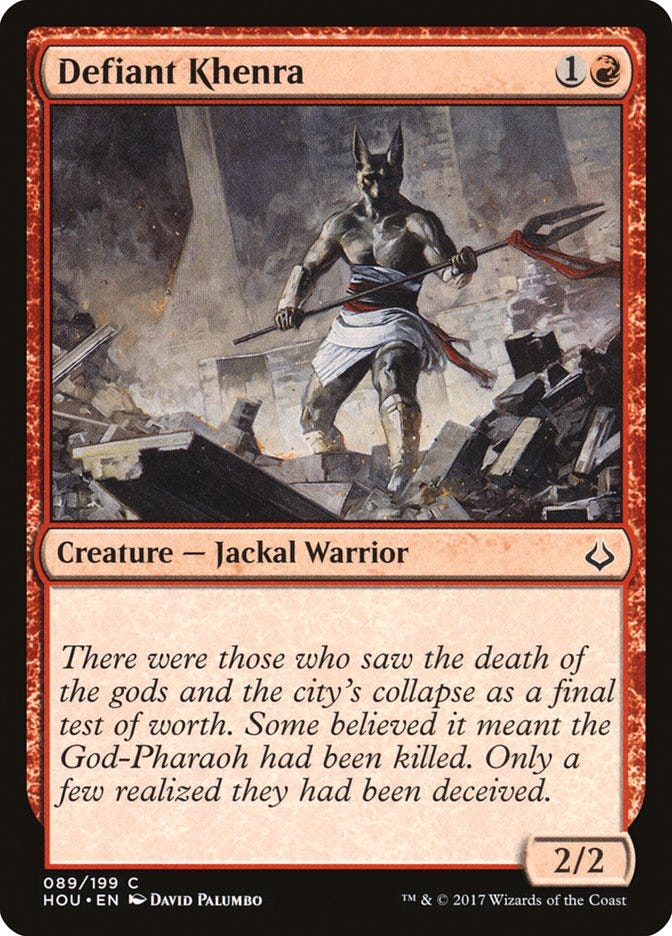
And this is where Amonkhet comes rushing back into view. The initiates who enter the Trials are desperate, not just for glory but for meaning, for proof that their lives add up to something. Their thirst is just as real as Sinuhe’s—sometimes literally, sometimes spiritually. And the tragedy is the same: devotion doesn’t always quench it. Sometimes faith in your old way of life leaves you wandering, mouth dry, realizing too late that you’ve been following a false promise. We know that as the gods were killed before the Amonkheti, many people still held faith in their God-Pharaoh before realizing they’d been betrayed by him. Look at the flavor text on Defiant Khenra:
“There were those who saw the death of the gods and the city’s collapse as a final test of worth. Some believed it meant the God-Pharaoh had been killed. Only a few realized they had been deceived.”
So, we see the difference in the stories now. Sinuhe’s story ends with grace. Pharaoh Senusret I welcomes him home, forgives him, and even gives him an honored burial. It’s a story about reconciliation, about a lost son returning to where he belongs. Amonkhet, however, doesn’t get that ending. Nicol Bolas is no merciful king. His betrayal scorches everything, leaving only ruins. And maybe that’s why the story of Sinuhe lingers in my mind when I think about Amonkhet: it reminds me that stories of exile and longing could go either way. They could end in forgiveness, or they could end in sand.
Hymnal of the Betrayed
The Tale of Sinuhe shows us the ache of exile and the fragility of belonging, while Amonkhet shows us the ache of betrayal. Faith isn’t just tested in small, private ways—it’s shattered. And sometimes, the betrayal comes not from strangers, but from the very figure you’ve built your life around.
When I first read the story of Amonkhet, I was struck by how the God-Pharaoh’s promises mirrored the hymns and rituals I had admired in Egyptian poetry. Everything seemed orderly, sacred, purposeful. The Trials, the festivals, the celebrations of death—they all radiated devotion. But then Nicol Bolas is revealed and the Hour of Devastation crashes into view.
The God-Pharaoh is not benevolent, not divine in the way the initiates believed. Every promise, every ritual, every line of flavor text that had felt like poetry before now carries the weight of that deception.
That hit me in a way I didn’t expect. Reading those lines about initiates striving for glory, sacrificing themselves for a divine reward they’d been taught to believe in, I couldn’t help but remember my own moments of misplaced faith. There were people I trusted, adults I believed had my best interests at heart, moments where I followed the rules and did the work because I thought it would make life better, only to be met with indifference or worse. The sting of betrayal is nothing new, but seeing it framed in Amonkhet—so ritualized, so public, so absolute—made it personal again.
Take, for example, the initiates marching into the Trials, hearts full of devotion:
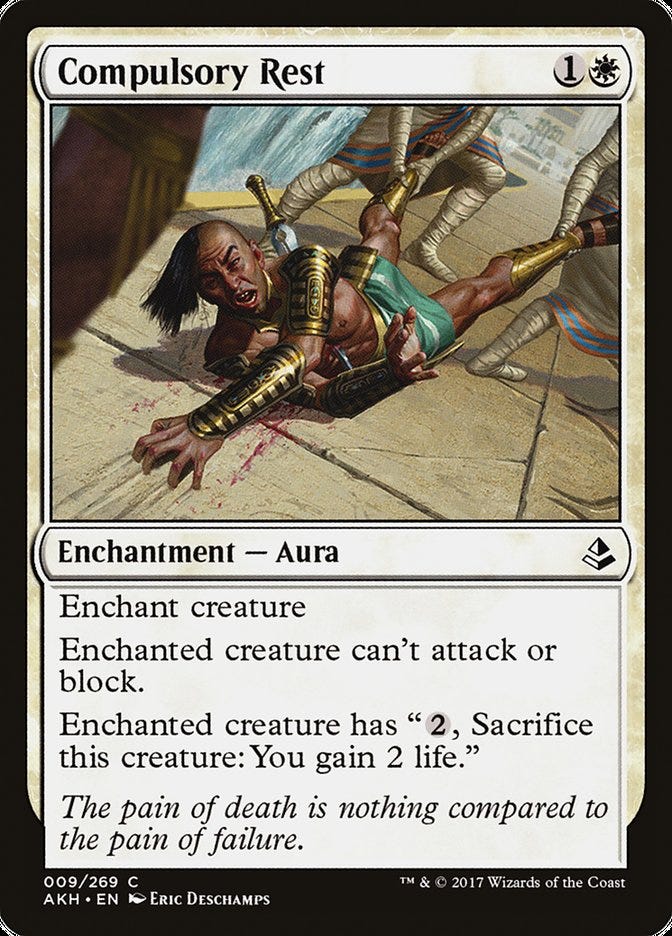
“The pain of death is nothing compared to the pain of failure.”
Reading that on the card Compulsory Rest, I feel both admiration and dread. The line is beautiful, almost hymn-like, until you realize it’s also terrifying. It’s a world where obedience is currency, and failure is annihilation. And it mirrors the lessons I had to learn in my own life: that faith—whether in people, institutions, or ideas—can be manipulated, can be weaponized.
Betrayal in this context isn’t dramatic or violent—it’s quiet and systemic. It’s the realization that the world may not reward your devotion in the way you imagined. Yet, paradoxically, that is where some of the deepest lessons emerge. Just as Sinuhe learns that life abroad cannot replace what he lost at home, the initiates of Amonkhet learn that devotion without discernment can blind you. Faith is powerful by design—but only if tempered with understanding.
And maybe that’s the cruelest truth of all: it’s not that faith is wrong. It’s that oftentimes faith alone isn’t enough. You can sing the hymns, recite the prayers, endure the trials—but if the foundations are rotten, if the figure you’ve placed at the center of your world is a tyrant in disguise, devotion becomes a kind of suffering.
This is what made reading Amonkhet so difficult and yet so compelling for me. It reminded me that betrayal isn’t only a story device—it’s a lived experience for us all. And facing that, surviving it, and still finding a way to care, to act, to try again—that’s the part that feels heroic, even when the world itself seems bent toward cruelty.
Beyond the Hekma
Looking back, what strikes me most about Amonkhet isn’t just the story itself, but the way it’s told. Through the trials and the hymns—they carry a rhythm and weight that feel familiar to anyone who has read Egyptian poetry or studied ancient stories like The Tale of Sinuhe. There’s a cadence to devotion, a layering of repetition and reflection, that transforms ordinary events into something almost sacred. We know that this isn’t solely an Egyptian concept either, Vyasa wrote the epic poem Mahabharata, Homer wrote the Odyssey. In all of these and especially in both Ancient Egypt and Amonkhet, storytelling isn’t just about what happens—it’s about how it is told, the lessons hidden between lines, the tension between faith and doubt.
The betrayal at the heart of Amonkhet is the revelation that the God-Pharaoh is not benevolent, and this hits harder because the narrative builds slowly, ceremoniously, just like Egyptian hymns and tales. Faith is cultivated in every stanza, every ritual, every card flavor text, so when that faith is broken, the weight of it feels real. It’s a lesson in storytelling as much as it is a lesson in devotion: the way a story is structured, the way it uses repetition, metaphor, and ritualized moments, shapes our emotional response as much as the events themselves.
Ultimately, Amonkhet just reminds me that the power of these stories lies in their form as much as their content. Just as the Egyptians used poetry to explore life and death, Wizards of the Coast crafted a world where every component contributes to a narrative that is as intricate and haunting as any hymn or tale from antiquity. It’s a testament to the enduring influence of these ancient forms, and to the way storytelling—whether written on papyrus or printed on cardboard—can leave a lasting impact.
Sources: Lichtheim, M., & Fischer-Elfert, Hans-W. (2006). Ancient Egyptian Literature : Volume II: The New Kingdom. University of California Press.
Bullock, R. (1978). The Story of Sinuhe. Probsthain.


 The Ravnican Reading Nook
Leave a comment