
Chaos is Relative
This week I wanted to take a break from my Edge of Eternities campaign and talk about my favorite aspect of Commander/EDH—interaction.
Now, I know. I know. It’s easy to flinch a little when the word “interaction” gets tossed around in a game of Commander. For some of us, it conjures up immediate trauma responses—sudden, jarring flashbacks to that one friend who built mono-Blue control and never let us have anything. You’re sitting there, five turns into a well-crafted plan, and just as you’re about to pop off? Swan Song. Counterspell. Maybe even a cheeky Pact of Negation just to really ruin your day.
Cue the dramatic music and overhead helicopters as we remember the worst of it—Cyclonic Rift resolving at the end step before someone’s alpha strike. The whole board gets picked up like someone just flipped the table and said, “No, thank you.” And don’t even get me started on Narset’s Reversal. That’s not just a counter. That’s a you-didn’t-read-the-fine-print-on-your-own-sorcery kind of moment.
But here’s the thing—that’s only one flavor of interaction.
Commander is an incredibly broad format, and what interaction looks like can shift wildly depending on the table, the power level, and the personalities of the people playing. Sure, blue has the reputation for being the “fun police,” and sometimes that’s earned. But interaction isn’t just about saying “no” to what someone else is doing. It can also be about nudging, redirecting, tempting, or even weaponizing the social aspect of the format. It’s not always a hard stop. Sometimes it’s a gentle redirection… into chaos.
So today, I want to celebrate the type of interaction I love most—the messy, political, you-sure-you-want-to-do-that? kind. The kind that doesn’t necessarily win you the game directly, but definitely makes it more interesting for everyone at the table. The kind that encourages weird alliances, suspicious deals, and that magical moment when someone says, “Wait, whose side are you on?”
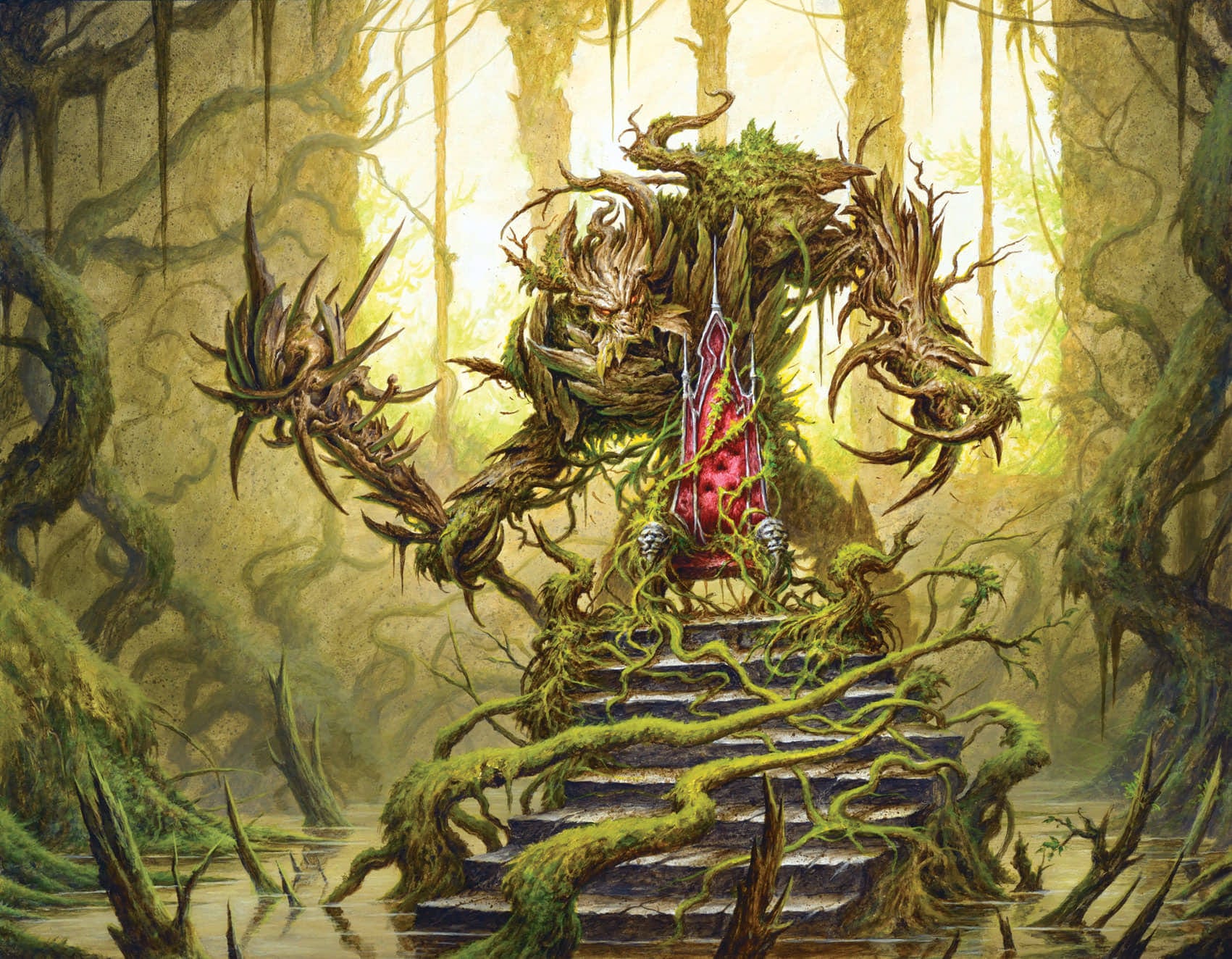
And to do that, I thought I’d give a deck tech on my absolute favorite little nightmare child: Sol’Kanar, the Tainted.
This deck isn’t trying to lock the board down or counter every spell. It’s here to get people talking. It’s here to tilt heads and make deals. It’s built around misdirection, manipulation, and just enough firepower to stay relevant—while keeping everyone else just a little bit off-balance. Sol’Kanar is the perfect commander for interaction that isn’t about control—it’s about corruption.
So if you’re interested in the art of subtle sabotage and want to hear about a deck that makes every game feel like a political thriller with just a hint of black oil dripping from the edges—stick around. Let’s talk about Chaos.
First up! The Tainted himself: Sol’Kanar.
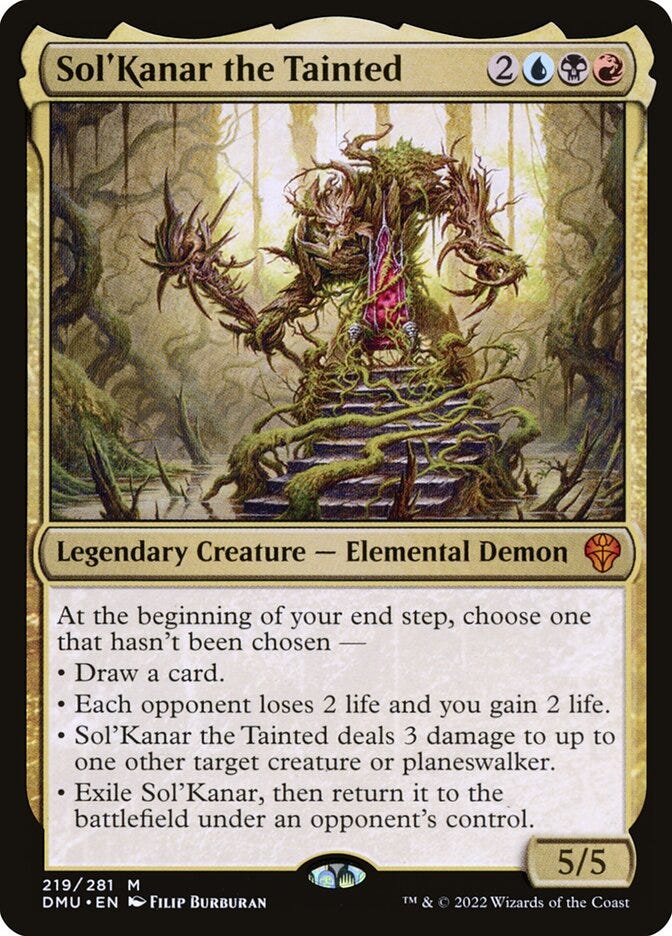
Now, I need you to understand—this commander came last. Originally, this deck wasn’t Grixis at all. It started as a mono-red Norin the Wary brew that leaned hard into goblins, self-harm, and general table nonsense. That deck was a mess, but it was my mess. And over time, as my collection grew, I found myself wishing Norin could do a little more. I wanted a home for all my favorite chaotic interactions—cards that didn’t make sense anywhere else. And once I admitted to myself that this was more than just a red deck gone off the rails, the answer was obvious:
Grixis. Because nothing says “controlled demolition with unpredictable results” quite like blue, black, and red all shaking hands and lighting the fuse.
And who better to command this delightful, volatile hellscape than a creature I literally have to give away at regular intervals?
Sol’Kanar’s abilities are perfect:
- Draw a card? Absolutely. I’m going to need that card when people inevitably get tired of my shit and start focusing me down.
- Each opponent loses 2 life and I gain 2? Look, it’s not flashy, but it adds up, and more importantly—it stirs the pot just enough to draw attention without painting a full target on my back.
- Deal 3 damage to a creature or planeswalker? Utility removal that’s just inconvenient enough to be annoying, but never quite enough to feel “worth” removing Sol’Kanar over.
- Give him to an opponent? YES. Let him go on his little adventure. Let him be someone else’s problem for a while. Let them deal with the curse of choosing an ability every end step.
The genius of Sol’Kanar is that he’s never yours for long. Every end step, you have to choose one of these effects, and you can’t repeat yourself. So it’s a rotation of utility, damage, and disruption—with a free plane ticket to your opponent’s board once you run out of options.
And here’s the kicker: I never try to protect him. I don’t slap boots or totems or greaves on him. If you’ve got removal? Use it. If you can profit from killing him? Go for it. I want him to die. I want him back. This is a deck where your commander is less of a figurehead and more of a cursed artifact that keeps finding its way home.
Sol’Kanar isn’t here to win the game. He’s here to make sure nobody else does it cleanly either.
Let’s keep going. I’ve got some real nonsense to show you.
I Beg Your Pardon?
Next, I wanna run you through what I affectionately call the “Beg Your Pardon” suite of cards. These are the pieces in the deck that let me break the fourth wall of gameplay and invite another player into my world, even if just for a moment. These aren’t hard interaction pieces. They’re social contracts wrapped in card sleeves. They give me the opportunity to look across the table, tilt my head just so, and say:
“Please, sir, would you be so kind as to help me ruin everything?”
It’s all about temporary alliances. Shaky truces. The illusion of control. These cards give my opponents the chance to participate in something chaotic—but with just enough agency that they feel like it was their idea.
First two up: The Toymaker’s Trap and a long-time personal favorite, Wheel of Misfortune.
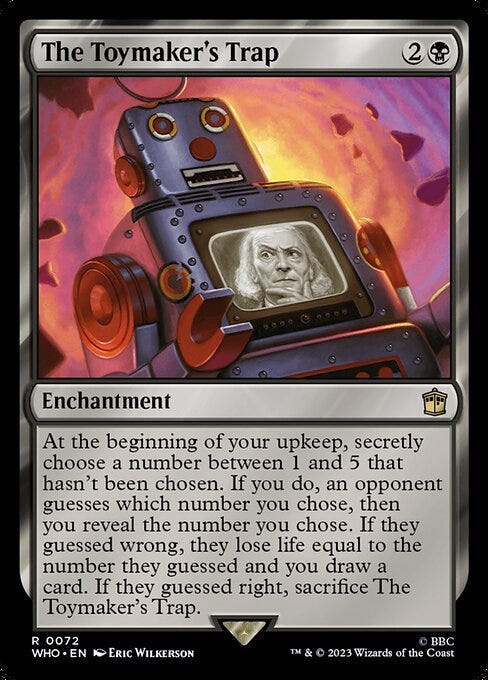
Now, The Toymaker’s Trap is already such a goofy little design. It’s like asking someone to play a side game of 5D chess in the middle of a poker match. It sets up a riddle, a mechanical puzzle—something that forces the table to stop and collectively go, “Wait, what exactly happens now?” I live for that moment.
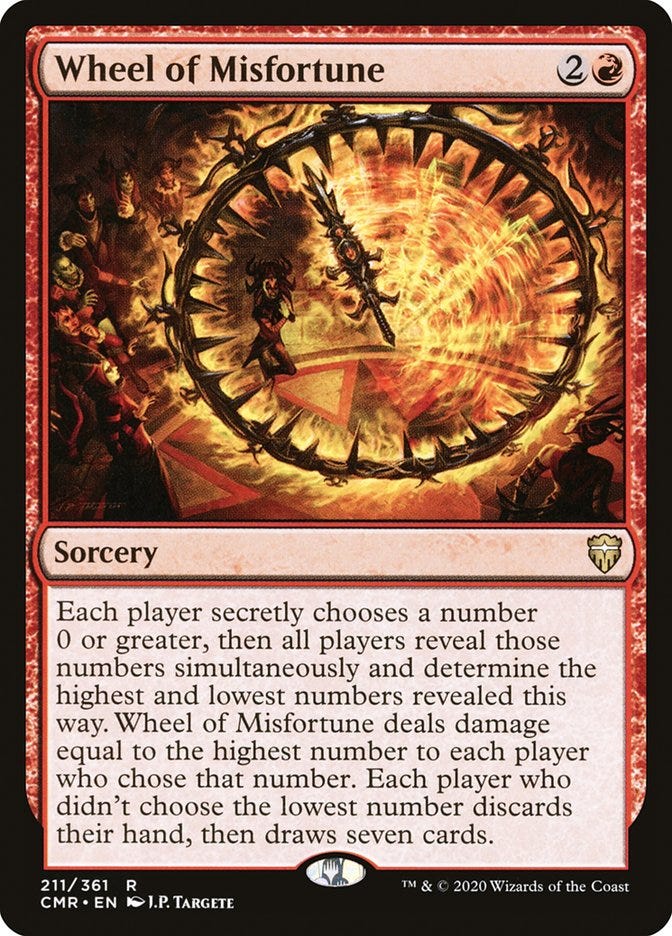
Then there’s Wheel of Misfortune, which is… chef’s kiss levels of chaotic interaction. Do you like numbers? Fantastic. Because I’m about to ask you to pick one. Secretly. At random. And then hope you didn’t just price yourself out of the round. It’s one of those cards where the effect is good—but the drama is what you’re really here for. That little moment of negotiation, bluffing, misreading the room? That’s the juice.
Then we have the mono-red menace duo: Mana Clash and Mindclaw Shaman.
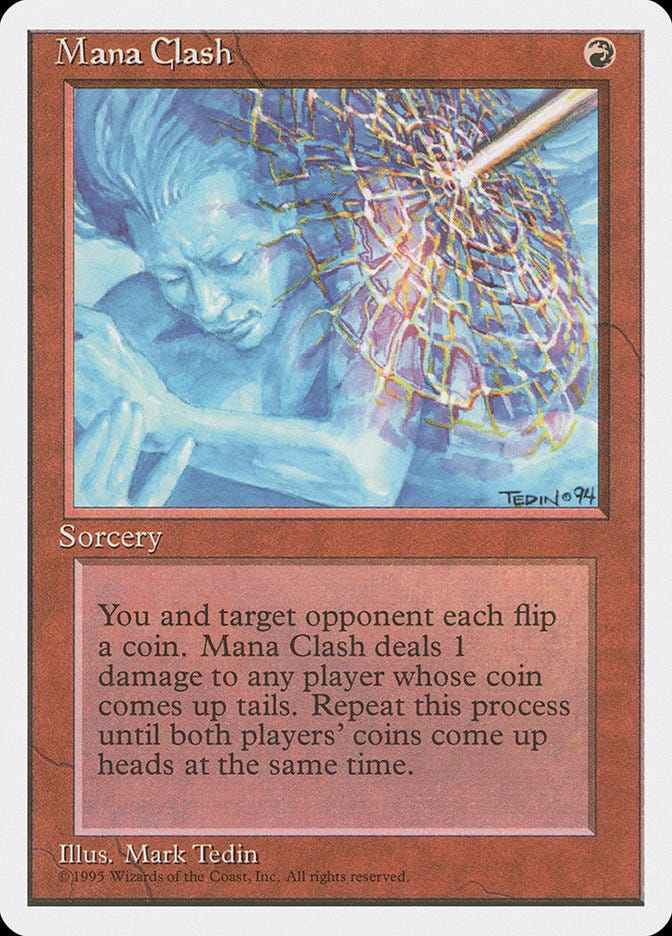
Mana Clash is pure nonsense. It’s a game within the game. It’s like saying, “Let’s flip coins until something explodes,” and inviting someone to sit down and play chicken with chance. It does almost nothing, except start a completely arbitrary pissing match that’s just as likely to backfire on me as it is on them—and that’s why it rules.
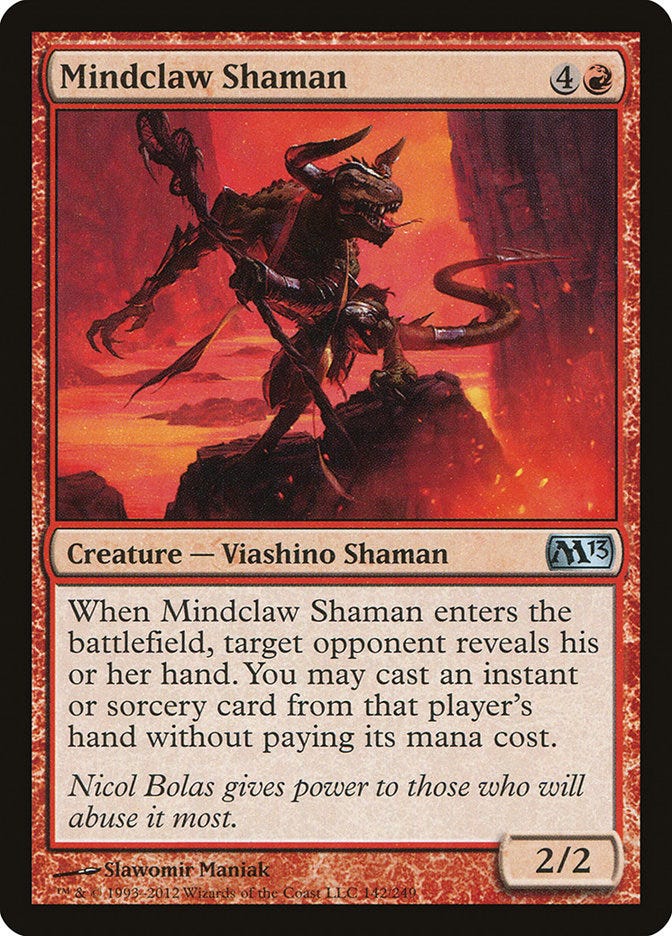
Then there’s Mindclaw Shaman, a card that I cannot believe isn’t in more red decks. It lets me dig into someone else’s hand, take their precious spell, and cast it for me. It’s not theft, exactly—it’s more like an unauthorized loan, and while they’re still processing that emotional betrayal, the game keeps moving. It’s interactive, disruptive, and just uncomfortable enough to be memorable.
And finally, we get to the big decisions—the moments where I get to lean back, throw up my hands, and say, “It’s not up to me anymore.”
That’s where Fact or Fiction and Ensnared by the Mara come in.
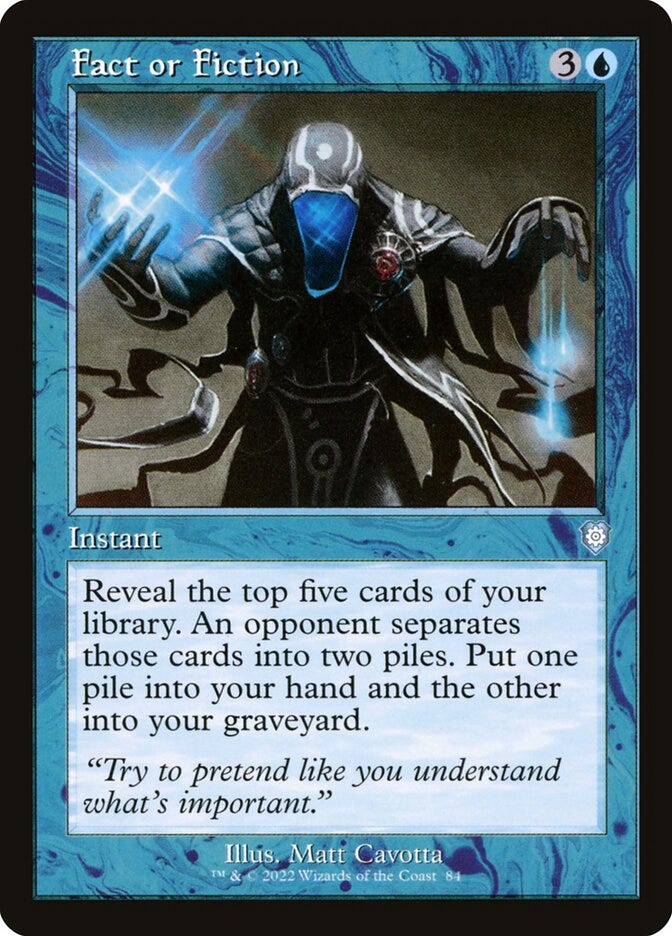
Fact or Fiction is a classic. But in this deck, it isn’t just card advantage. It’s a stage performance. Who will I choose to split the pile? What does it say about our relationship? Will they give me what I need, or try to screw me over and accidentally hand me exactly the chaos I wanted? The tension isn’t just in the cards—it’s in the politics.
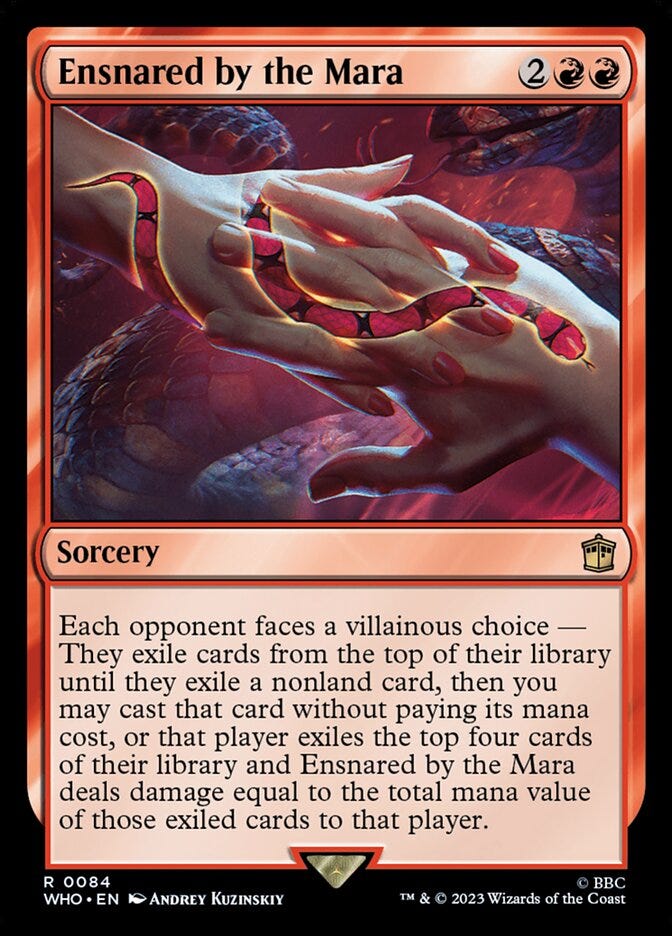
Ensnared by the Mara is similar in spirit. It creates a moment of real, delicious pressure. My opponents are being asked to make a choice—and that choice is going to ripple out across the table. Do I get to cast whatever that top card is? Or would you rather risk the top four being lost forever? It’s interactive in the most psychological sense. It forces people to play the game outside the game.
So that’s the “Beg Your Pardon” suite—cards that pretend to ask politely, while really planting seeds of confusion, mischief, and temporary allegiance. Because sometimes the most powerful move isn’t casting a bomb or countering a threat—it’s asking someone else to make the hard decision… and then enjoying the aftermath.
Sorry, WTF?
Cool, we got the question-asking cards covered. Now let’s talk about the part of the deck that really gives it its soul—or whatever twisted sludge is pulsing in its place. Welcome to what I call the “What the Fuck?” suite of cards.
These are the primordial soup of this deck. The bubbling, oozing, toxic tar pit from which the rest of the chaos crawled. If everything else in the list is a conversation, a negotiation, or a clever trick… these cards are just a brick through the window. These are the fundamentals. The foundations. The goo.
Let’s talk about my favorite bombs. And no, I don’t mean “bomb” in the classic Magic sense—big mana, big threat, big value. I mean bomb like “Oops, everything exploded. I’m not even sure why.” I mean actual detonation. Emotional and otherwise.
Let’s start with the most iconic piece of table tension I run: Larry Niven’s Disk (Nevinyrral’s Disk).
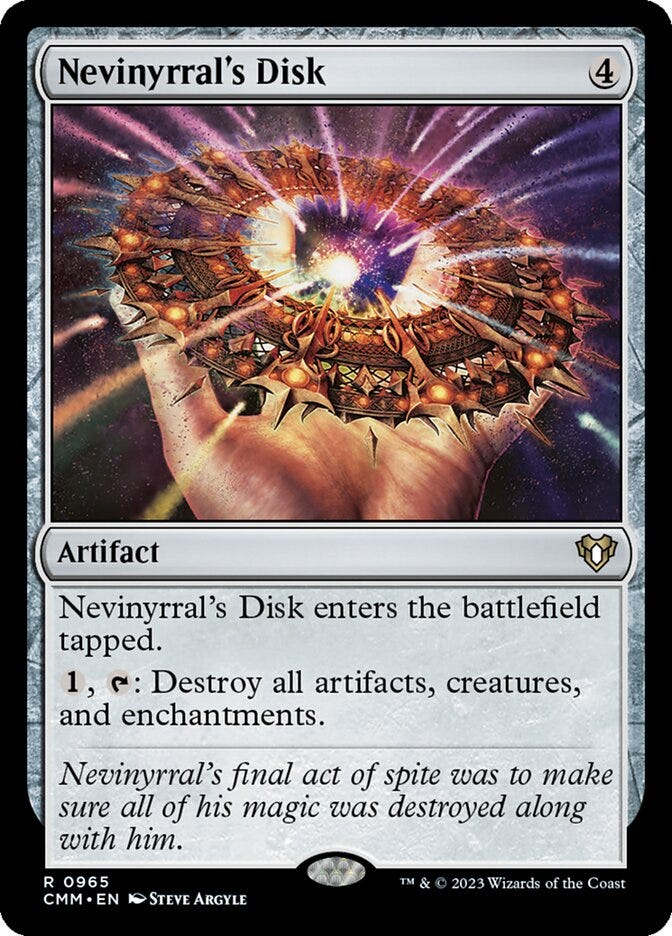
This card is the equivalent of sitting down at a high-stakes poker game and placing a loaded pistol in the middle of the table, slow and deliberate. You don’t even have to touch it—just its presence does the work. Everyone sees it. Everyone feels it. Conversations get quieter. Eyes dart a little more. Nobody wants to make the first wrong move. “Oh, did you just go a little too wide with your board? That’s interesting.”
I don’t even always use the Disk. Sometimes it’s enough that it’s just… there. Glinting. Waiting. A cold reminder that sometimes peace is only temporary. And I love that. It’s not a threat, it’s a promise hanging in the air.
Then there’s Boompile, a beautiful leftover from this deck’s earlier form—back when it was mono-red goblins and little else. But I kept Boompile around, because chaos this pure deserves reverence.
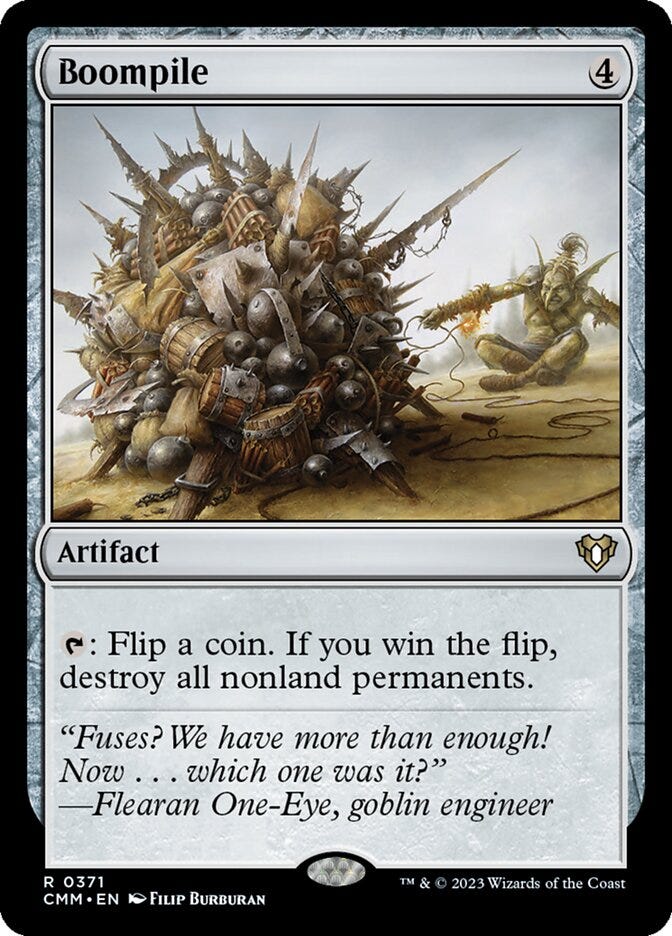
You press a button and maybe everything goes away. Or maybe nothing happens. And that’s the game. That’s life. Boompile doesn’t care about your carefully assembled engine, your value chain, or your devotion math. Boompile asks one question, and that question is “Are you feeling lucky?”
Sometimes it’s a total dud. Other times? It’s a nuclear reset that spares nobody. And the best part? I didn’t even target you. The coin did it. That’s not betrayal—that’s just entropy.
Continuing on the artifact path, we arrive at one of the dumbest cards I adore: Aeon Engine.
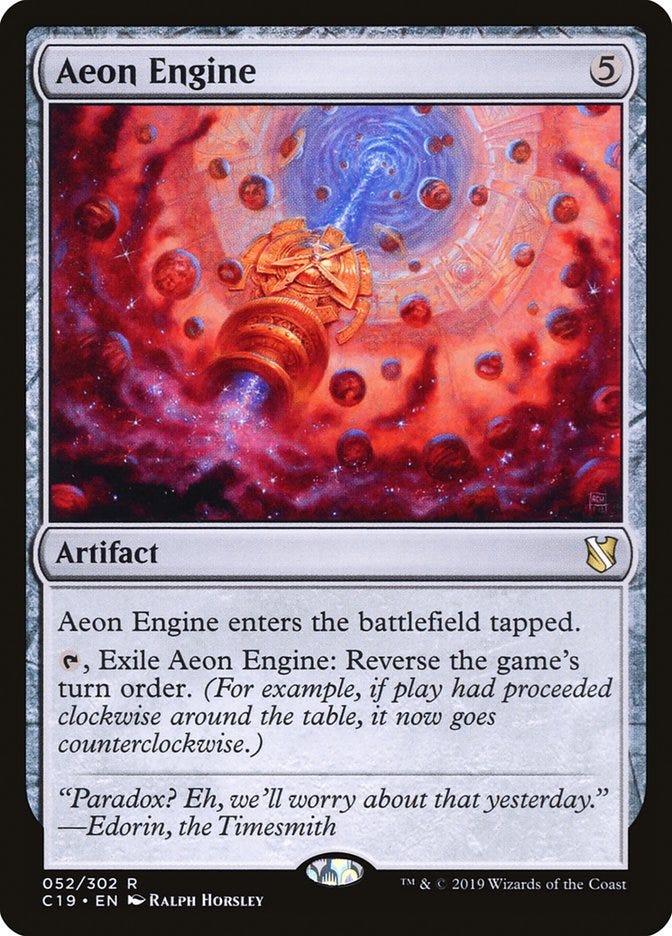
This card? This card shouldn’t be good. It shouldn’t even exist. But here it is, and every time I draw it, it feels like I’m holding a cheat code written in a forgotten language. Reverse the turn order. That’s it. That’s the whole thing. It doesn’t draw me cards, doesn’t wipe the board, doesn’t generate mana. It just janks the fundamental architecture of the table.
Imagine your friend has been planning the turn—the one they’ve been foreshadowing with smug little comments and carefully untapped lands. The table braces. You can feel the momentum building. And then?
Boom. I wind back the clock and give the turn to someone else. Isn’t that amazing? It’s the card equivalent of leaning over and pulling the fire alarm just because you can.
It’s not even that it gives me an edge—it’s that it yanks the narrative sideways. I live for those narrative left turns.
Now we move into proper red territory. Let’s talk about two of my absolute chaos gems: Molten Psyche and Warp World.
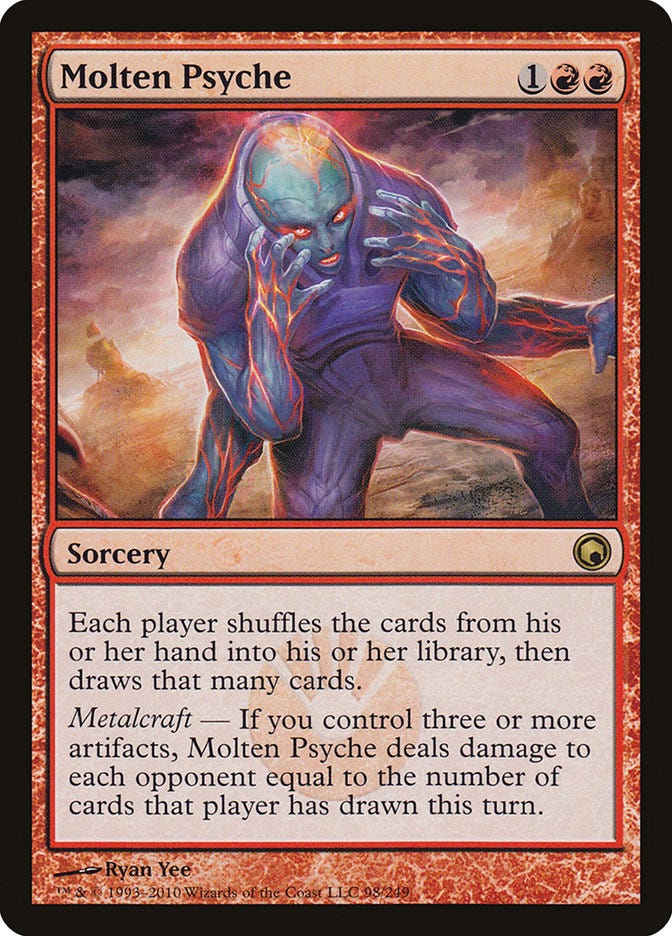
Let’s start with Molten Psyche—a card that should probably be talked about more often. It’s a wheel, sure. Every player shuffles their hand into their library and draws that many cards. That alone is a respectable piece of disruption, especially in a deck like mine that never really cares what’s in my hand—it’s about keeping the pot stirred. But then comes the kicker:
If I control three or more artifacts, each opponent takes damage equal to the number of cards they draw.
Which they will. Because we’re all drawing. And guess what? I do control three or more artifacts. Always. Because I built it that way. And now, for just three mana, I’ve turned a group hug spell into a group punch in the face. It’s delightful. It’s vicious. It’s value on fire.
But none of that—none of that—compares to the granddaddy of all chaos cards. The great white buffalo.
Warp World.
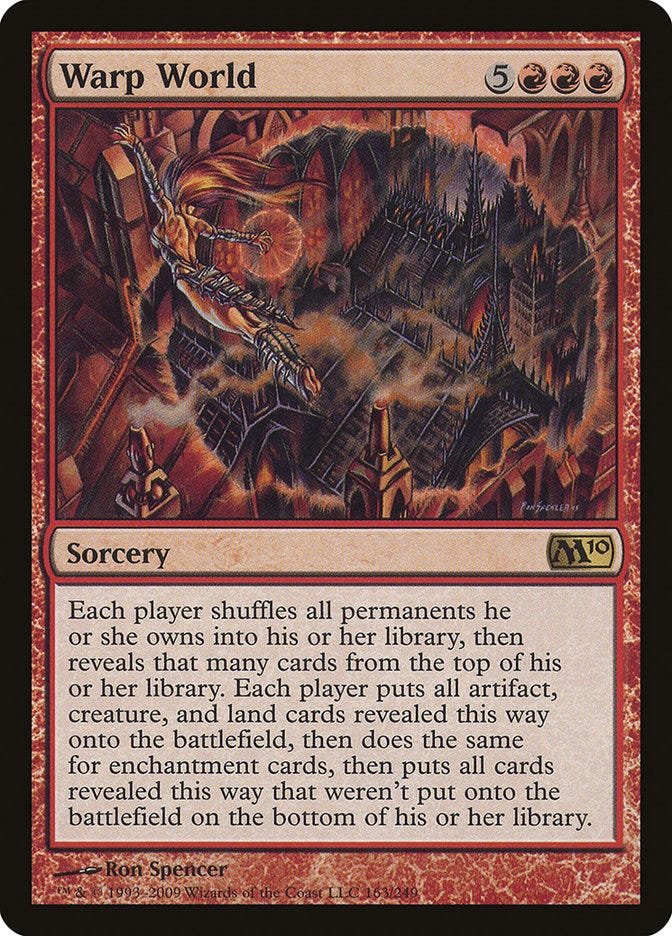
Oh, Warp World. If this deck had a patron saint, it would be you—serene and smiling, surrounded by flaming ruins.
Let me just read it again for the people in the back:
“Each player shuffles all permanents they own into their library, then reveals that many cards from the top of their library. Each player puts all artifact, creature, and land cards revealed this way onto the battlefield.”
Let me say that again: All. Permanents. Go. Back.
Hands off the chess board. Flip the table. And then build it again.
I love this card so much it should probably be sleeved in velvet. Every time I cast it, it feels like I’m giving the table a gift: the gift of unpredictability. We all lose everything. We all get something back. And none of us have any clue what the board is going to look like when the dust settles.
You might end up with a better board. You might get stuck with a pile of lands and sadness. But either way? You’ll remember the moment it happened.
Sometimes I win off it. Sometimes I flip Emrakul. Sometimes I flip garbage and start again. But I always get exactly what I wanted: a complete and utter reshuffling of expectations.
So that’s the “What the Fuck?” suite.
These are the cards that don’t ask questions, don’t offer deals, and don’t leave room for negotiation. They detonate assumptions. They yank the wheel and see where the car ends up. They’re the beating heart of my deck’s identity—not because they’re efficient or synergistic—but because they create moments.
Because when the dust settles and someone asks, “What just happened?” I get to smile and say:
“You tell me.”
Now, I’m not going to go through every single card in this deck—because, frankly, I respect your time and attention span. Plus, the full list will be linked in this article, so you can go fall down that rabbit hole at your own leisure. But before I wrap this up, I need—no, I require—to dedicate this final section to my one true love. My baby. My muse. My ride-or-die. My sweet cheese boi: Knowledge Pool.
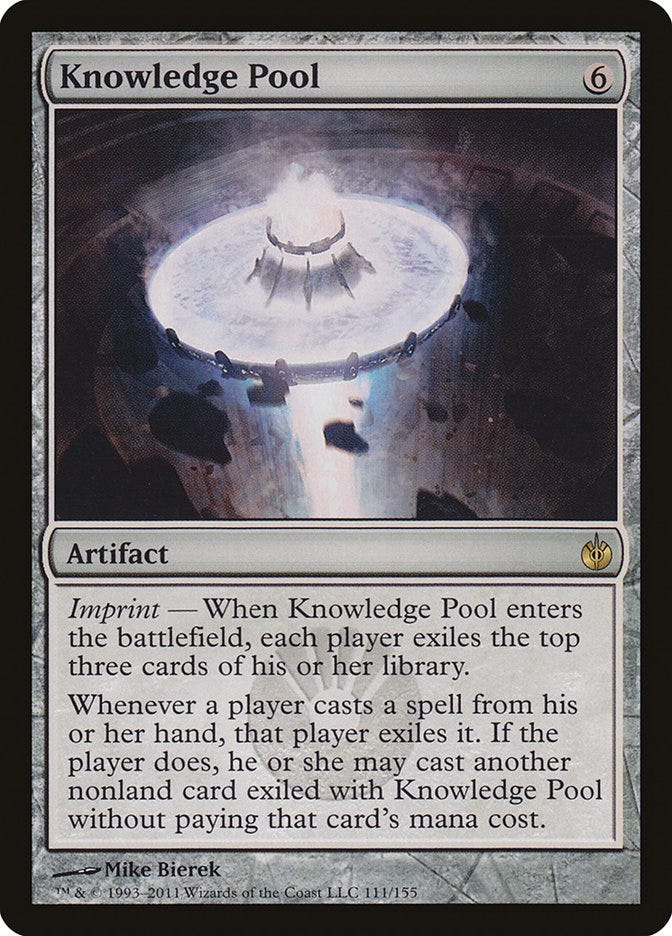
This card… this card is not just a piece of cardboard. It’s a philosophy. A lifestyle. A commitment to making Magic a shared hallucination. For the low, low cost of six colorless mana—six!—you too can cause an entire Commander pod to let out a collective, guttural groan. Not of pain. Not of defeat. But of existential awareness. The kind that says, “Oh no. It’s going to be one of those games.”
And honestly? Isn’t that the point? Isn’t that what we signed up for?
Think about it. Picture every game of Commander you’ve ever played. The great ones, the forgettable ones, the ones where that guy combo’d off on turn four but insisted it was a “casual deck.” Got them all in your head? Great. Now imagine if every one of those games had included Knowledge Pool.
You wouldn’t have played your deck. You would’ve played everyone’s deck. All at once. With no rhyme, no reason, and absolutely zero consistency.
Now that’s Magic as Richard Garfield–definitely–intended.
So what does this divine engine of mayhem actually do?
Let me take you on a journey.
Knowledge Pool enters the battlefield and immediately triggers Imprint. Which means each player—yes, every single one of us sinners at the table—exiles the top three cards of their library. Boom. Gone. Into the pool. A swirling soup of potential. A communal fever dream. Let’s give it a name. Something original. Something with gravitas.
Let’s call it… the “Pool of Knowledge.”
And once this Pool is established, the rules of reality are suspended. We are no longer playing four separate decks. We are playing one 400-card deck of utter nonsense, and it is shared between us all. It is nobody’s. It is everybody’s. It is sacred.
Here’s the catch—and this is where the magic happens:
Anytime someone casts a spell from their hand, that spell doesn’t resolve. Oh no, my friend. That spell is unceremoniously dumped into the pool. In exchange, they may cast something else from the pool—completely for free.
So you pay 1 mana for a humble Sol Ring, and in return, you walk away with a 13-mana Eldrazi titan. Or maybe you shell out 10 mana for Omniscience, dreaming of infinite power, only to walk away with… a Goblin Chainwhirler. Congratulations!
It is chaotic. It is completely detached from any reasonable concept of value. It is magnificent.
But here’s the real secret: it isn’t just a card. It’s a theatrical production. It is the moment someone forgets it’s on the board and taps out for their combo piece. It is the pure, shining light in your eyes when you say, “Are you sure you want to cast that?”
It is the way the table’s mood shifts—from strategy to storytelling. From gameplay to gameplay-as-performance.
This card takes every expectation, every well-oiled game plan, and throws it into the pool to see what floats. And whether you sink or swim? That’s not up to you anymore.
I love this card with every fiber of my soul. I love it the way some people love their pets or their favorite childhood blanket or the exact way their partner makes their coffee. I love it with a sincerity that makes people uncomfortable. And when I tell you that I would put one in every deck if I could, I mean that.
But, alas. I am not the only person at the table.
I am surrounded by reasonable people. People who enjoy interaction and agency and being able to cast their spells without them falling into a chaos blender. And because I enjoy having friends, and because I sometimes enjoy completing a game, I’ve made sacrifices.
I’ve bent the knee to the social contract of fair and casual gameplay. I’ve agreed—begrudgingly—that not every deck needs to be a Rube Goldberg machine of shared agony.
I could run Knowledge Pool in everything.
But I don’t.
Because I’m a coward. A coward with manners.
But in this deck?
This one shining, glorious pile of nonsense?
Oh, you better believe he’s here. And every time I draw him, I smile. Because I know—for the next few turns—we’re not playing a deck alone, we’re playing a deck together, comrade.
Well, that’s it. That’s my baby.
This deck lives unsleeved, housed in a gloriously crinkled Ziploc bag that I am pretty sure has seen more travel than most of my luggage. It rattles when I carry it. It clacks ominously when it hits the table. It doesn’t sparkle or intimidate, but it draws attention—like some unholy artifact someone definitely should have left buried in the desert
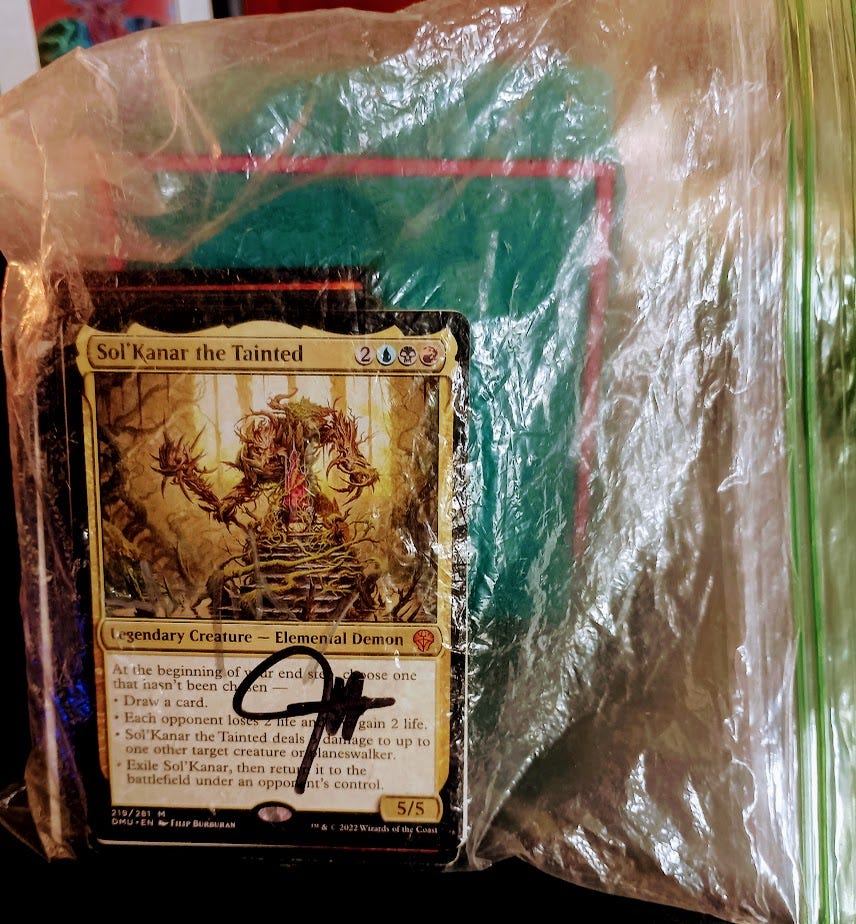
It is deeply, profoundly not precious in the way most Commander decks are precious. And yet, it’s the most precious thing I own in Magic. I bring it everywhere. To casual nights, to LGS meetups, to conventions. If I’m traveling and there’s even a whisper of a chance that someone might want to jam a game, that Ziploc is coming with me. It’s my weird little talisman.
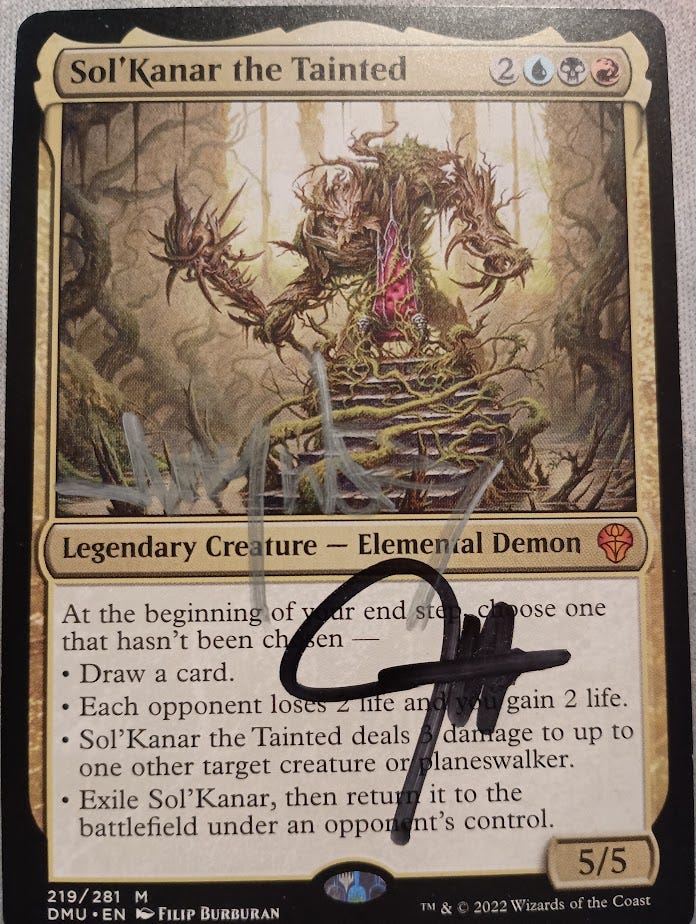
And yes, I do have people sign the cards.
Some signatures are from friends. Some are from MtG Creators who I meet in passing during a con–Sol’Kanar is signed by Jimmy and Josh of Game Knights fame, for example. Some are inside jokes that I forgot the origin of years ago. But together, they’ve turned this pile of jank into something that feels more like a guestbook than a decklist. Every time I open it, it’s like flipping through a scrapbook built entirely out of chaos and social contracts
.
So, hey—if you see me at a con, and you want to see it? Play against it? Sign a card? Ask me why the hell I’m still running Mana Clash in the year of our lord 2025? I am literally always down.
Now, let’s be honest for a second.
Is the deck perfect? No.
Is it optimized in any traditional sense of the word? Absolutely not.
There is no curve. No reliable wincon. No synergy map or flowchart or backup plan. It’s a disaster. A beautiful one. And it works exactly as intended.
Because this deck does the one thing I care about most—every single time I play it.
It makes people talk. It forces us into conversation.
We plan together. We scheme. We negotiate.
We laugh, we sigh, we bluff, we panic.
We yell. We whisper. We call each other fools and geniuses in equal measure.
And that’s it. That’s the point.
This game has always been, for me, about the table—about what happens in that liminal space between four people holding a hand of cards and a shared sense of imagination. The chaos is a vehicle. The nonsense is the glue. And this deck—which you can find here— this ridiculous, half-melted trash fire of a deck, is my love letter to that space.
Because for all the strategy and spectacle, all the spells and synergies, I really only want one thing out of Commander:
Interaction.
 The Ravnican Reading Nook
Leave a comment