
A Childhood in Chocolate, a Universe in Conflict
The air is scented with powdered sugar and loose Earl-Grey tea leaves. It’s a brisk autumn day just outside of Chicago, and my brother and I couldn’t be more excited.
We’re going to stay with HER.
Growing up, my mom had 2 aunts –MK and Mindy– and they couldn’t have been more different. One was rich, travelled the world, had a pool table and a beautiful home in Oak Park, a more affluent area of the Chicago suburbs. But the other aunt was Mindy, and that is who we have come to visit on this auspicious Autumn morning. See, she wasn’t rich. She barely travelled and when she did it was to cake-decorating conferences. She didn’t have a pool table, she didn’t have a massive home, she didn’t have a lot to be honest. Yet, if you’d ask my brother and I, her house was the best!
We learned to make candy, sculpt with chocolate, make AND decorate cakes. She had an attic that we stayed in and she always kept the mini fridge stocked with all our favorite foods and drinks. We would stay up late watching Doctor Who and Torchwood, we would have our own high tea ceremonies in her living room surrounded by her collection of teapots. It was heaven.

Mindy passed away a few years ago during the pandemic and it hit me really hard. To be honest I’m not sure that I’ve gotten through it even now, but I still find her places. In the whistle of my kettle on the stove I can hear her calling us downstairs. In the scent of chocolate I find myself in her kitchen again, somehow that room always smelled like a Lindt factory. In the mechanical whir of the Tardis I am transported, again, to her small book room, perched on the ground watching Eccleston on dvd with headphones on.
So much of what I value today, I inherited from her and in that way everything I do today is a reflection of the worlds she showed me.
This isn’t surprising, really, considering I was raised for the most part by a single mom working multiple jobs. So strong women, powerful female energy, has always been where I feel the most at home. And my aunt was powerful. She had a presence that you couldn’t ignore, she was abrasive to many, she knew how much space she wanted, and she took it up –a skill I have yet to acquire.
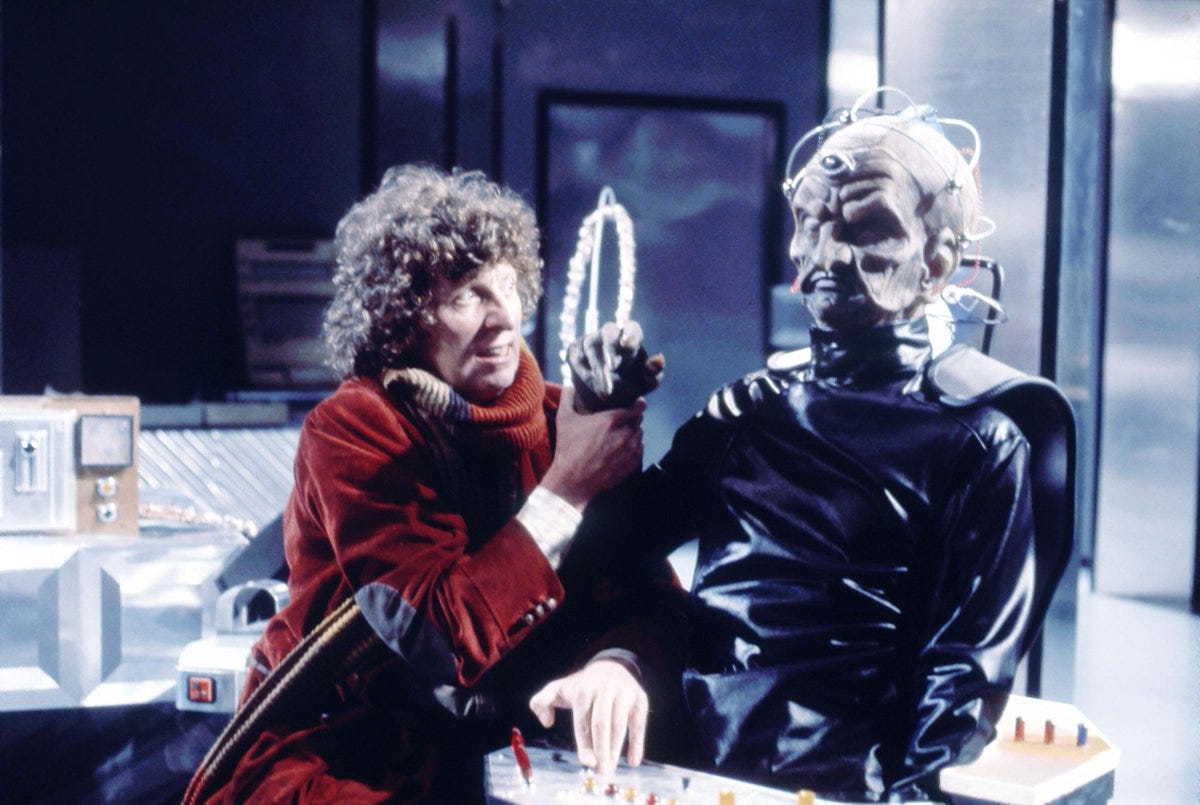
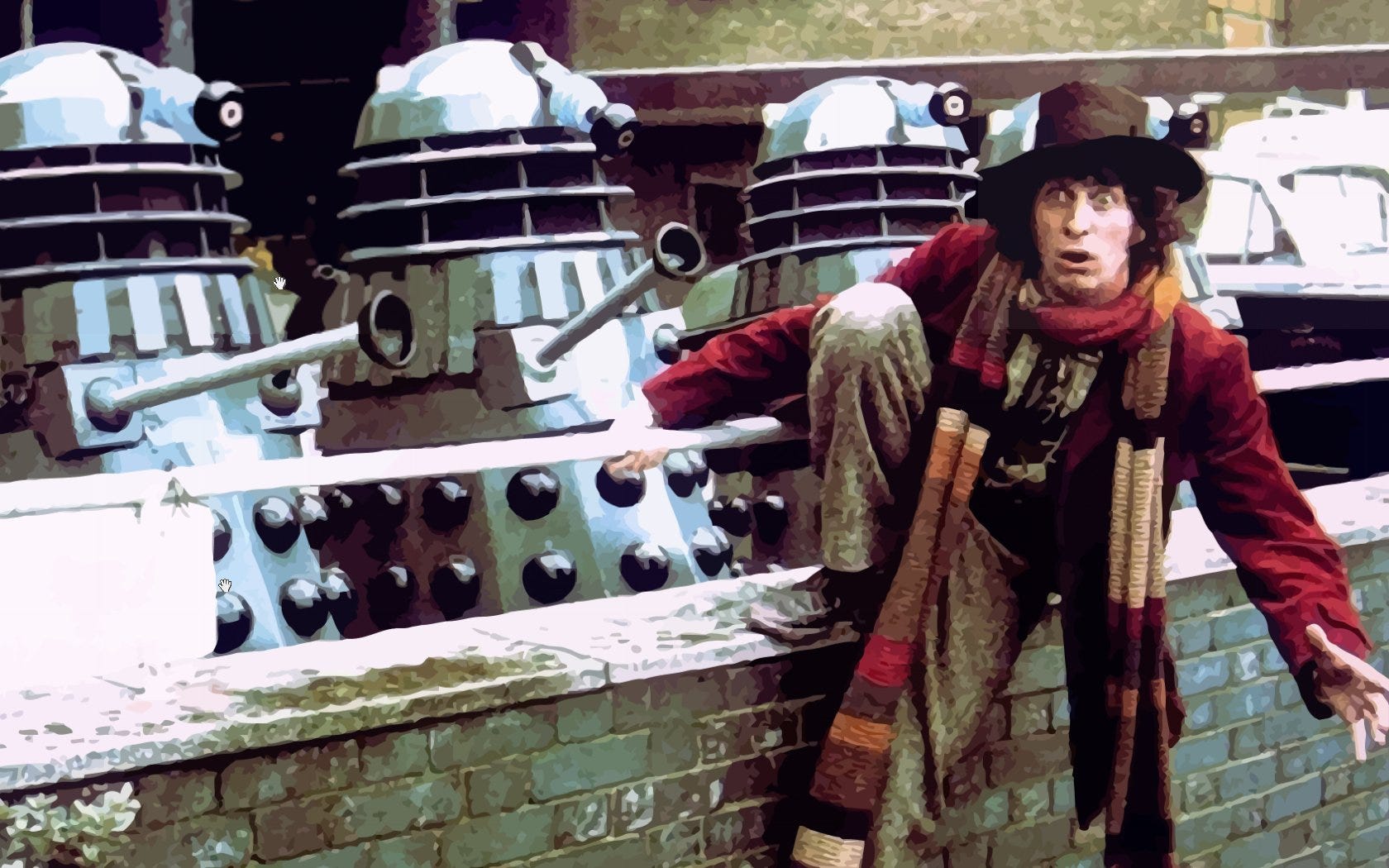
Anyway…why am I writing about this, about her? A few days ago, I found myself watching “Genesis of the Daleks,” a Doctor Who multi-part special during Tom Baker’s reign as the travelling space hipster. In this special, Tom Baker’s Doctor is attempting –poorly– to stop Davros from creating the Daleks.
I hear what you’re saying, “wtf does this have to do with magic?” Well shut up and let me finish dude. Geez.
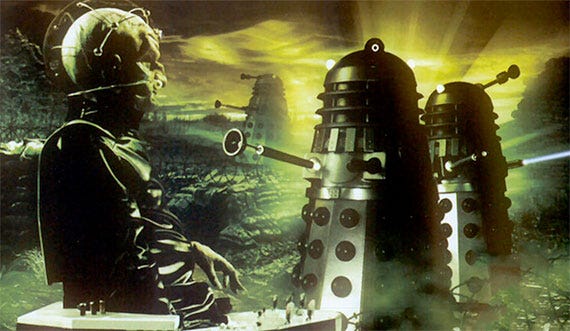
Anyway, the Daleks used to be a race known as the Kaleds (clever I know) and they were at war with a race known as the Thals. Davros uses his wit and manipulation to convince the Thals to bomb the Kaleds because they are an evil and inferior race that the Thals have hated for a long time anyway. However, what they don’t know is that Davros wants to use this attack to motivate and justify his new race of Daleks, get it…it’s Kaled backwards because they’re evil now. The Doctor tries to stop this “Genesis” but fails in the end, only slowing their inevitable rise instead.
These episodes hold a special place in my heart because Tom Baker was her favorite Doctor. My mom’s too actually. So I always feel their presence when I watch them.
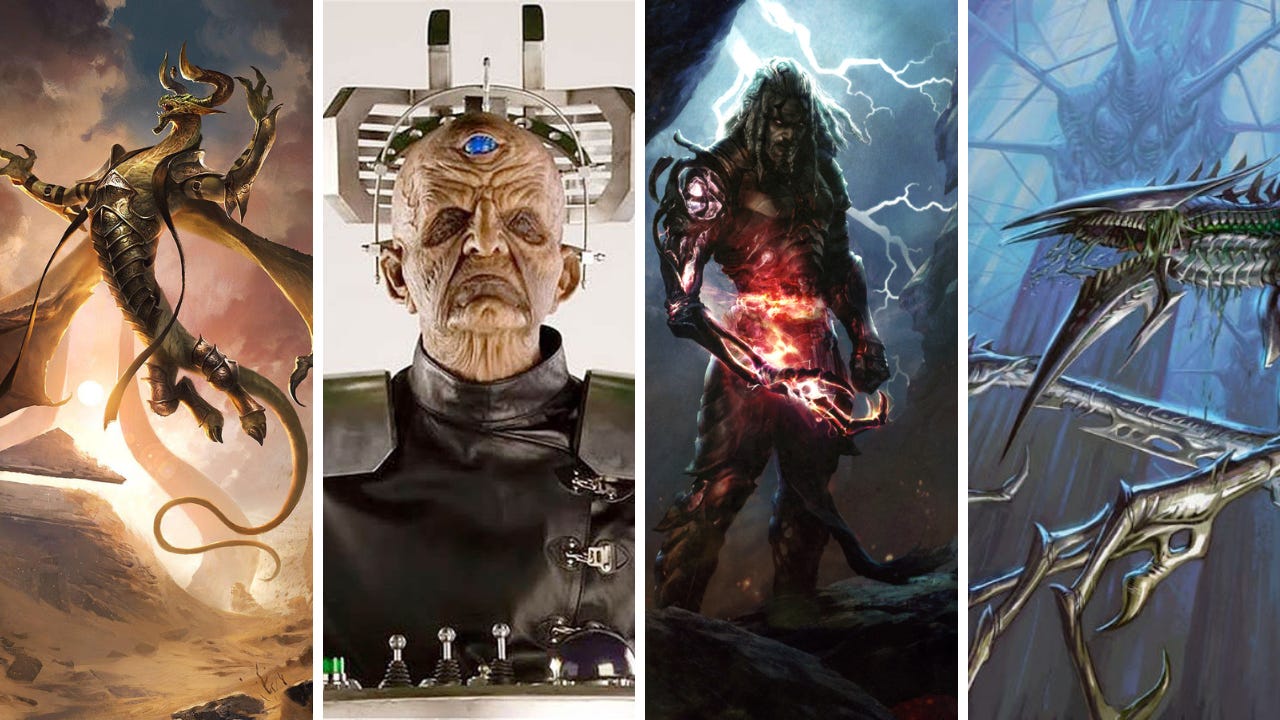
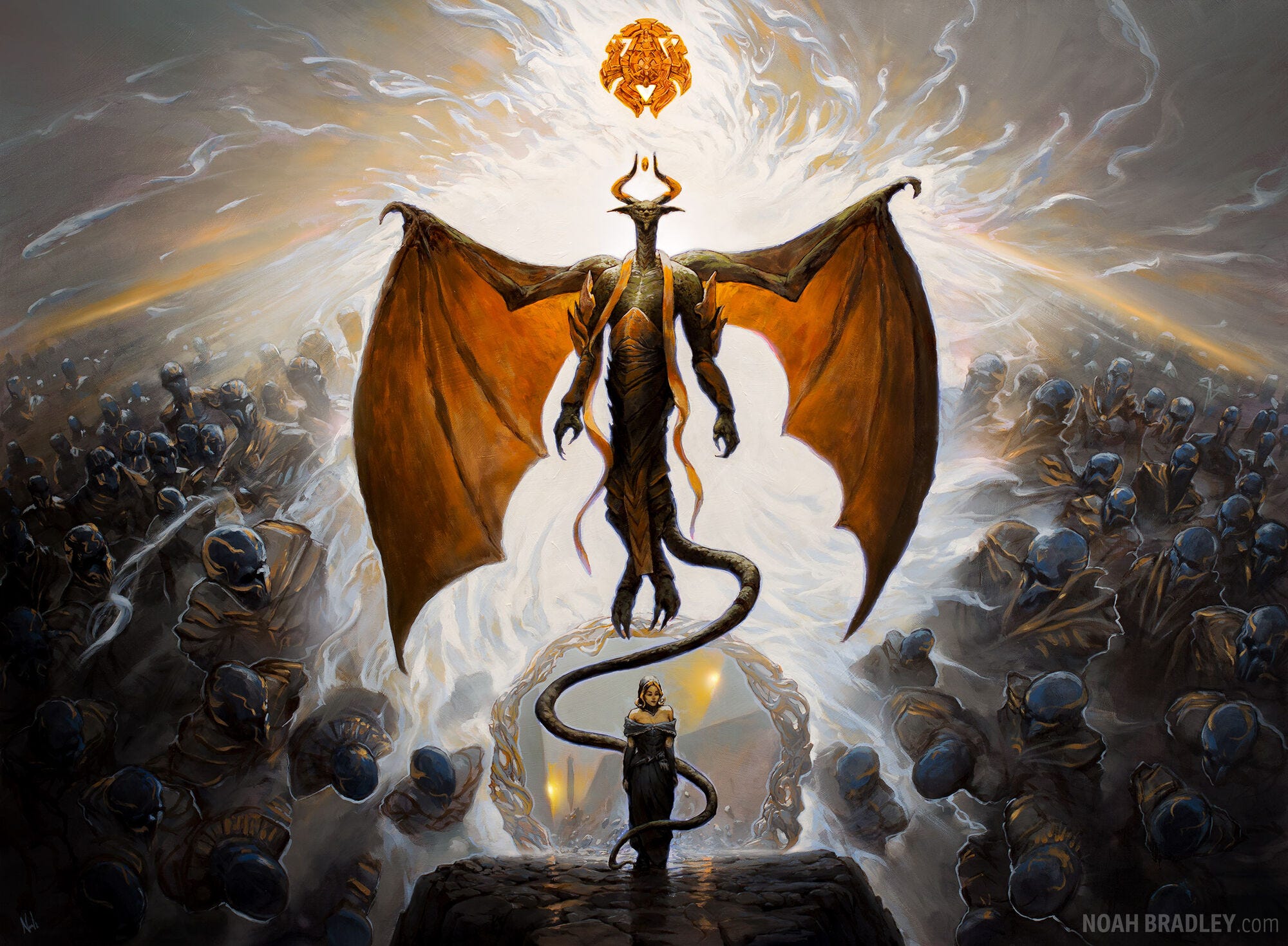
In this case, though, I also felt like I was watching Nicol Bolas, Tezzeret, or even Elesh Norn when I saw Davros’ scheming. In these episodes he is subtle. He’s manipulative. He can have you, as the audience, questioning whose side he’s on at any time. These are all aspects I associate with Magic’s villains as well.
From Yawgmoth’s cold logic to Tezzeret’s ego-fueled tinkering, from Nicol Bolas’ centuries-spanning schemes to the Phyrexians’ warped utopianism—these are not impulsive, rage-fueled antagonists. These are planners. Engineers of destiny. The kind of villains who would absolutely look the Doctor in the eye and say, “I’ve already won.”
So, let’s talk about that. About how the scheming, slowly boiling evil of Davros finds echoes in Magic’s greatest threats. About why we’re drawn to villains with vision. And why sometimes, the scariest thing about a villain isn’t their power—it’s their belief that they’re building something better
One of the most haunting things about Genesis of the Daleks—and what really stuck with me even as a kid—is how Davros never just fought his enemies. He made them fight each other. Watching him manipulate the Kaled government, all while feigning loyalty to them, was like watching someone play five-dimensional chess. He knew exactly how to pull the right emotional levers, to spark doubt, division, and fear. By the time anyone realized they were just pawns, Davros had already closed the board.
And look, I’m not saying Nicol Bolas is Davros—but I’m also not not saying that.
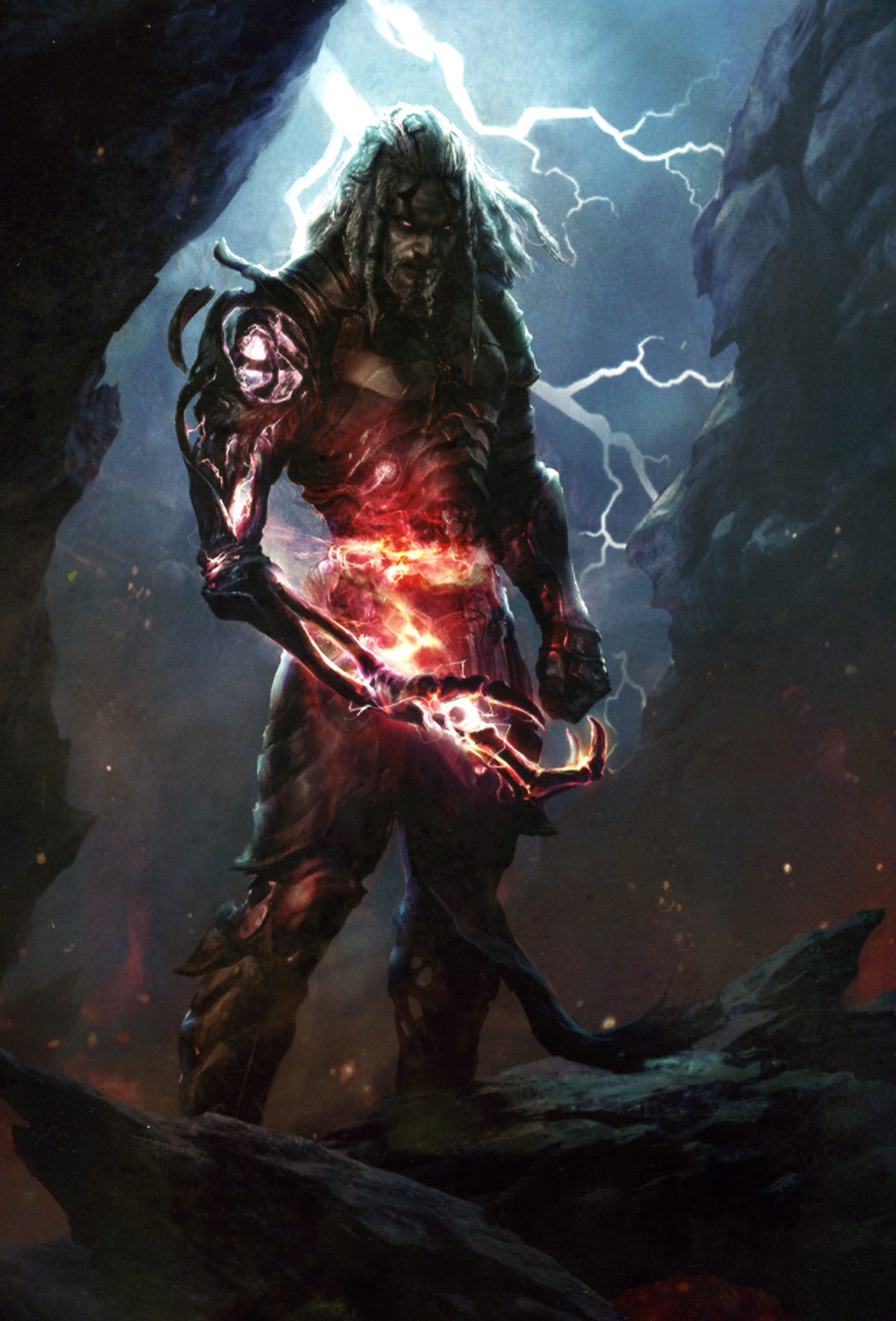
Bolas perfected the art of indirect domination. He doesn’t just conquer with force—he destabilizes, corrupts, whispers. In War of the Spark, half the reason the plane-wide battle hits so hard is because Bolas has spent years quietly fracturing allegiances. He arms the enemy just to provoke a bigger war. He sets up false choices and watches as the so-called heroes choose wrong. Bolas doesn’t need to win every battle—he just needs everyone else to waste their energy on each other.
Tezzeret’s the same flavor of awful. He’s the guy who always shows up in Act II with a smile and a knife, ready to betray whoever’s winning. Whether he’s aligning himself with Bolas, the Consulate, or the Phyrexians (again), Tezzeret plays sides like a DJ spinning records—only ever loyal to his own power. He thrives in conflict zones, where he can stoke both ends of the fire and then walk away with whatever survives.
And what’s so unnerving about all of this—whether it’s Davros in his bunker or Bolas atop his citadel—is how calculated it is. There’s no rage. No panic. Just strategy. These are villains who understand that the best way to win is to never let your enemies realize they’re fighting the wrong war until it’s too late.
Watching Davros feed one faction just enough information to doom another, all while engineering the birth of the Daleks behind everyone’s back—it felt uncomfortably familiar after years of watching Magic’s villains operate. It’s the same dark thrill: that chilling realization that none of this was a coincidence. That someone, somewhere, is pulling the strings—and loving every second of it.
But if there’s one thread that connects Davros, Nicol Bolas, and Tezzeret like some kind of cosmic evil group chat, it’s this: they all think they’re building something better.
That’s what makes them dangerous. Not just their intellect, their magic, or their armies—but the conviction that everything they do is justified. Every betrayal, every death, every world left in ruins—it’s all necessary. A step toward a stronger, smarter, more orderly future.
Davros doesn’t just create the Daleks because he can. He creates them because he must, in his eyes. The Kaled-Thal war has dragged on for generations. His people are dying. The only path forward, he believes, is to engineer a superior race—one without mercy, without weakness, without doubt. He doesn’t think he’s birthing evil. He thinks he’s solving a problem.
That’s what terrified me as a kid. Davros doesn’t cackle like a cartoon villain (okay, not always). He lectures. He reasons. He argues that logic and survival demand the Daleks. And he’s so calm about it that, if you’re not careful, you start to wonder if he’s right. He gives big Thanos energy, but if Thanos was bound to a wheelchair and was infinitely more intelligent.
And Bolas? Same energy. His whole multiverse-spanning plan isn’t just about ruling for funsies—he sees himself as the only being strong and smart enough to impose real order on a chaotic, petty cosmos. The weak need culling. The strong need purpose. And only someone with his vision can deliver it. Never mind the cost. Never mind the centuries of blood. After all, isn’t the end result worth it?
Tezzeret’s even sneakier. He doesn’t wax poetic about utopia the way Bolas or Davros might, but his actions scream the same mindset. Tezzeret views morality as a tool. If allying with villains gets him closer to personal ascension—or some techno-magical enlightenment—so be it. The system’s already broken, he figures. Why not exploit it?
Both Doctor Who and Magic: The Gathering know exactly what they’re doing when they give us villains like this. They’re not just obstacles for the heroes to overcome—they’re philosophical landmines. They force everyone around them (and us, the audience) to reckon with uncomfortable questions:
At what point does compromise become corruption?
How many lives is peace worth?
If you could make the world perfect by destroying everything broken, would you?
Davros would say yes. Bolas would laugh that you even had to ask. And that’s the horror of it. These villains aren’t just evil—they’re believable. They echo the real-world dangers of ideology taken too far, of progress weaponized against empathy.
And in both universes, the real battle isn’t just physical—it’s ethical. It’s the quiet war over where you draw the line… and whether, once you’ve drawn it, you’ll ever know when you’ve crossed it.
It has been decades since I first saw Genesis of the Daleks, but I can still hear Davros’ voice, echoing off of the hanging teacups, in my head—that slow, chilling certainty, that unshakable belief that what he was doing was necessary. That story lodged itself in my brain long before I had the language to explain why. And maybe that’s the power of these kinds of villains—not just that they scare us, but that they make us think. That they challenge us to understand how easily logic becomes cruelty, how grand ideals curdle into horror if we stop questioning them.
When I see Magic’s villains pull the same strings—turning friends against each other, bending hope into fear—I feel the same chill I felt watching those old Doctor Who tapes on Mindy’s scratchy couch. The worlds are different, sure. One’s full of Planeswalkers and mana, and even Doctor Who characters; the other has time lords and sonic screwdrivers and…Doctor Who…characters. Oh. ANYWAY, the questions are the same. What do we owe each other? How do we stand in the face of power that believes it’s right? When compromise becomes a weapon, what’s left to believe in?
And I think that’s what makes both Doctor Who and Magic: The Gathering endure. They’re not just about explosions and clever twists (though I do love those too). They’re about people. About the messy, fragile, resilient thing that is humanity—how we break, how we hope, how we choose. And villains like Davros or Bolas? They’re the perfect test. They push us to the edge, and in doing so, help us find where we stand.
But more than anything, when I think about Davros, or Bolas, or the Blind Eternities, or the Time War, I think about my Aunt Mindy. About those autumn mornings and candy-making and those long, cozy nights where the biggest battles in the universe played out on a flickering screen while the smell of warm chocolate filled the room. That’s where I learned to love stories. That’s where I learned that villains can be brilliant and terrifying and tragic—and that good stories don’t just end, they echo.
Because in the end, it’s not just about who wins. It’s about why we keep watching. Why we keep playing. Why, even now, I find myself wondering what Davros would’ve said to Bolas over tea. And why I already know Mindy would’ve served it in her best teapot—because the battle between good and evil deserves nothing less than full ceremony.
That’s the magic of it all. And I wouldn’t trade it for the world.
January 29th is the anniversary of her passing. I always brew a pot of Earl-Grey, make a batch of her fudge, and watch Doctor Who. Rest in Peace, hope the vortex is a blast. ❤
 The Ravnican Reading Nook
Leave a comment